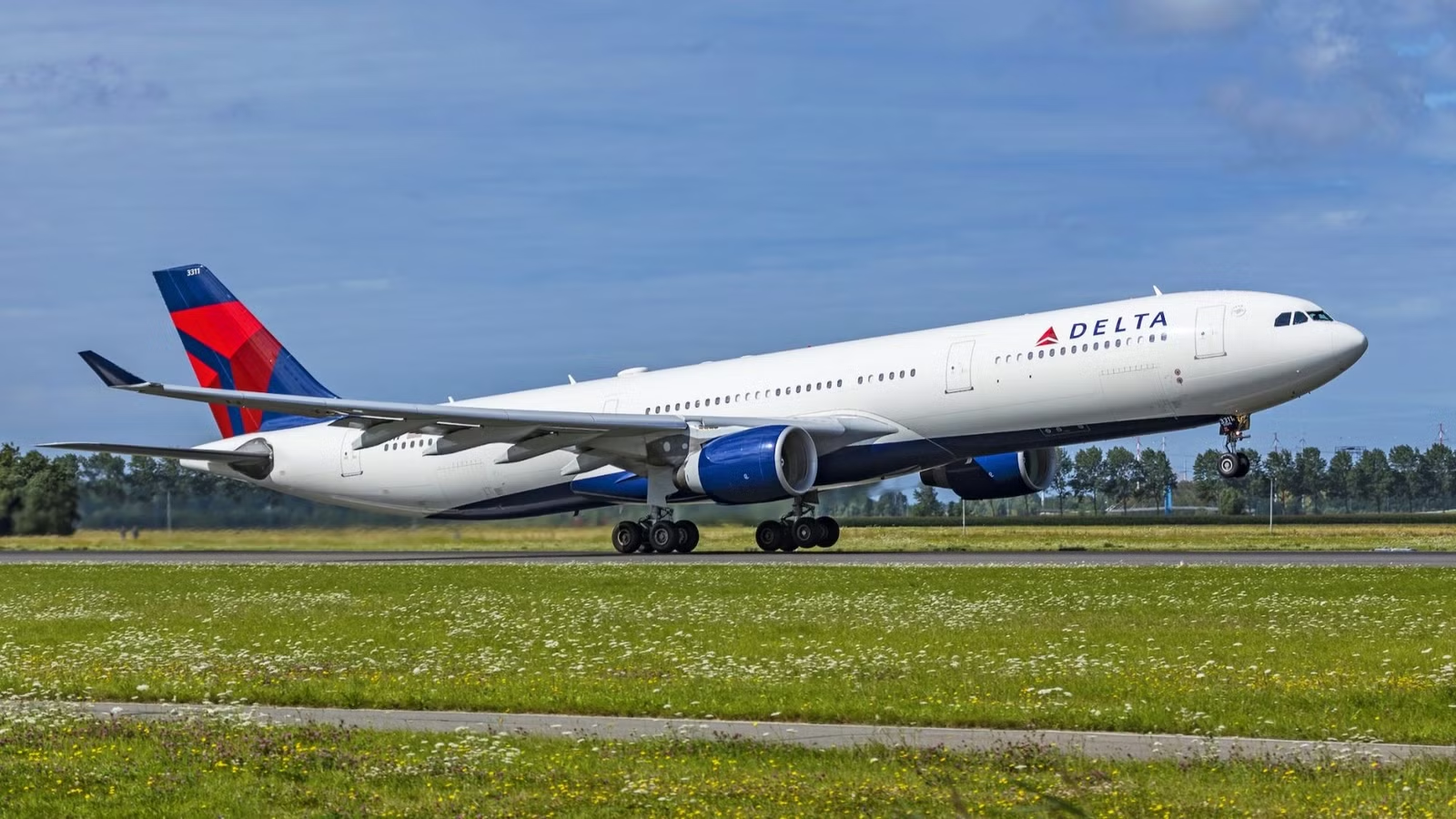

 Hartsfield-Jackson Atlanta International Airport is the world’s busiest airport, and the largest hub for
  Delta Air Lines. It served nearly 110 million passengers last year, bringing it back to pre-pandemic levels. Airport management, through its multi-billion-dollar ATLNext capital improvement program, is focused on modernizing the airport’s infrastructure and increasing operational capacity, with the goal of being able to serve 140 million passengers within a few years.
The obvious question is, why doesn’t Atlanta just build a second airport to relieve the pressure on a single hub? After all, most large US cities have more than one airport. But at a recent event, Delta CEO Ed Bastian shot down the idea, saying “a single airport in Atlanta has been one of the keys to our city’s success, and it’s going to be vital to its future.”
Bastian Dimisses The Idea Of A Second Atlanta Airport

Bastian was speaking alongside Ricky Smith, the new general manager at ATL, at an Atlanta Press Club event moderated by the Atlanta Journal-Constitution. He said that Delta is “very focused on improving the overall customer experience” at its fortress hub, acknowledging that “while it’s a great transit hub, we could be a better welcoming location as well.”
To this end, he notes that Delta and the airport have been making major investments in the expansion and modernization of the Central Passenger Terminal Complex (CPTC), highlighting improvements to the baggage handling system, security checkpoints, retail spaces, and information technology infrastructure. He also emphasized that “our future growth in Atlanta is international travel,” and said a priority is adding a luxury Delta One Lounge in Atlanta as well.
“There’s not a city in this country that wouldn’t die to have something like Hartsfield-Jackson in its backyard, with all the capabilities it brings. We need to capitalize on this world-leading asset that we have, and continue to invest in building an even larger, faster, and more economically-responsible model. A second airport is a distraction that would divert capital and traffic flows for a very low-end purpose.”
ATL Is Planning For 140 Million Annual Passengers

And those numbers are truly staggering. The ATLNext plan was originally put together for a total of 125 million annual passengers, which the airport expects to reach by 2030 based on current growth rates. However, if international expansion continues at its current clip — and Delta is certainly showing every sign of doing so — then it could be even sooner. Smith acknowledged that the airport is now taking a longer-term view, saying:
“We now have to look out to the point where we reach 140 million passengers, and we have to figure out what the infrastructure needs to look like to accommodate that level of traffic.”
A Look At The ATLNext Agenda

| Major ATLNext Capital Projects | |||
| Projects | Details | Investment | Completion |
| Concourse D Expansion | Widening of Concourse D from 60 feet to 99 feet, an increase in length, and height adjustments. It will add 10 new gates, double the size of holding rooms, expand restrooms, and install new concessions and amenities. The project uses innovative modular construction, with 19 prefabricated modules moved overnight to minimize disruptions. | $1.4 billion | Multiphase through 2029 |
| CPTC Modernization and Expansion | Renovating and expanding the main terminal, including the Atrium, North and South Domestic Terminals, and connections to concourses. A focus on optimizing traffic flows, accessibility, and aesthetics, in order to improve the passenger experience. | $4 billion | Multiphase through 2035 |
| Sixth Runway Construction | Development of a new parallel runway (approximately 10,000 feet long) to be constructed between runways 9R/27L and 10/28 (the fifth runway). The objective is to boost airfield capacity by 35%, reduce delays, and support more international and wide-body flights. | $1 billion | 2034 |
| Parking and Automated Transit System Improvements | A new seven-level parking deck adjacent to the South Terminal, adding nearly 7,000 spaces with smart technology for real-time availability. Future parking deck for the North Terminal, and transit system extensions to handle higher traffic. | $2.7 billion | Multiphase through 2030 |

Hartsfield-Jackson Atlanta International Airport
America/New_York