Notes
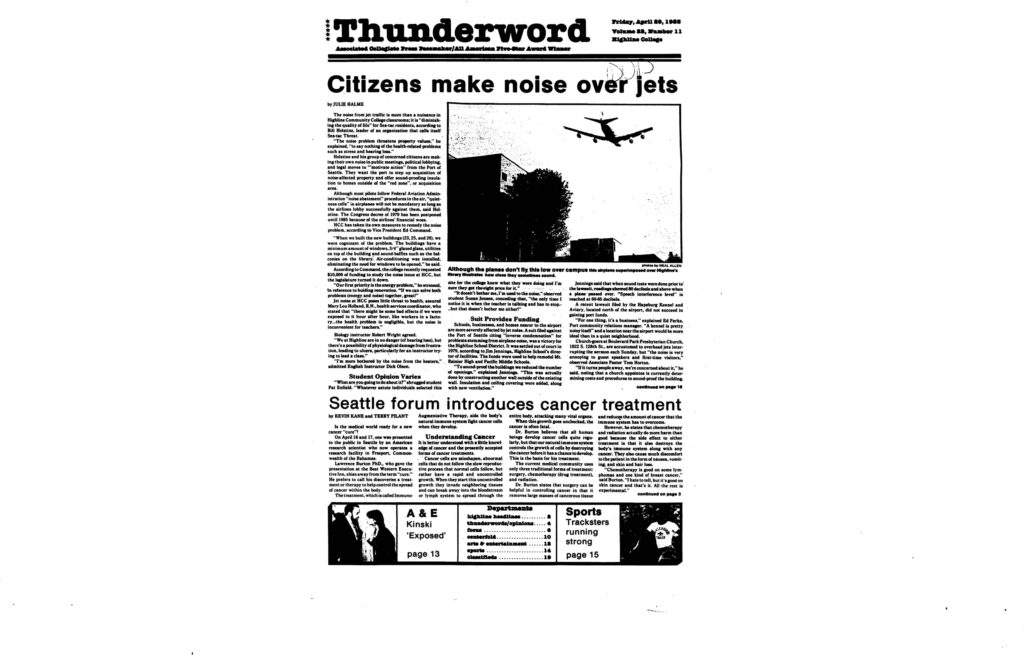
Student newspaper featuring article about citizens complaining about jet noise. It mentions a lawsuit settled out of court in 1979 concerning Inverse Condemnation. There are several anecdotes from instructors and the school nurse saying (incorrectly) that the noise poses no risk for human health.
Citizens make noise over jets
by JULIE HALME
The noise from jet traffic is more than a nuisance in Highline Community College classrooms; it is “diminishing the quality of life” for Sea-Tac residents, according to Bill Holstine, leader of an organization that calls itself a group of concerned citizens.
“The noise problem threatens property values,” he explained, “to say nothing of the health-related problems such as stress and hearing loss.”
Holstine and his group are making their own noise in public meetings, political lobbying, and legal moves to “motivate action” from the Port of Seattle. They want the Port to step up acquisition of noise-affected property and offer sound-proofing insulation to homes outside of the “red zone,” or acquisition area.
Although most pilots follow Federal Aviation Administration “noise abatement” procedures in the air, “quietness cells” in airplanes will not be mandatory as long as the airlines lobby successfully against them, said Holstine. The congressional decree of 1979 has been postponed until 1985 because of the airlines’ financial woes.
HCC has taken its own measures to remedy the noise problem, according to Vice President Ed Command.
“When we built the new buildings (23, 25, and 26), we were cognizant of the problem. The buildings have a minimum amount of windows, 3/4-inch glazed glass, utilities on top of the building and sound-baffles such as the balconies on the library. Air-conditioning was installed, eliminating the need for windows to be opened,” he said.
According to Command, the college recently requested $10,000 of funding to study the noise issue at HCC, but the legislature turned it down.
“Our first priority is the energy problem,” he stressed, in reference to building renovation. “If we can solve both problems (energy and noise) together, great!”
Jet noise at HCC poses little threat to health, assured Mary Lou Holland, R.N., health services coordinator, who stated that “there might be some bad effects if we were exposed to it hour after hour, like workers in a factory … the health problem is negligible, but the noise is inconvenient for teachers.”
Biology instructor Robert Wright agreed.
“We at Highline are in no danger (of hearing loss), but there’s a possibility of physiological damage from frustration, leading to ulcers, particularly for an instructor trying to lead a class.”
“I’m more bothered by the noise from the heaters,” admitted English instructor Dick Olson.
Student Opinion Varies
“What are you going to do about it?” shrugged one student.
Another student observed, “It doesn’t bother me, I’m used to the noise.” She conceded that “the only time I notice it is when the teacher is talking and has to stop — but that doesn’t bother me either!”
Schools, businesses, and homes nearer to the airport are more severely affected by jet noise. A suit filed against the Port of Seattle using “inverse condemnation” for problems stemming from airplane noise was a victory for the Highline School District. It was settled out of court in 1979, according to Jim Jennings, Highline School’s director of facilities. The funds were used to help remodel Mt. Rainier High and Pacific Middle Schools by constructing another wall outside of the existing wall. Insulation and ceiling covering were added along with new ventilation.
A recent lawsuit filed by the Hapsburg Kennel and Aviary, located north of the airport, did not succeed in gaining Port funds.
“For one thing, it’s a business,” explained Ed Parks, Port community relations manager. “A kennel is pretty noisy itself, and a location near the airport would be more ideal than in a quiet neighborhood.”
Church-goers at Boulevard Park Presbyterian Church, 1822 S. 128th St., are accustomed to overhead jets interrupting the sermon each Sunday, but “the noise is very annoying to guest speakers and first-time visitors,” observed Associate Pastor Tom Horton.
“If it turns people away, we’re concerned about it,” he said, noting that a church appointee is currently determining costs and procedures to sound-proof the building.
— continued on page 18