The Airport Communities Podcast
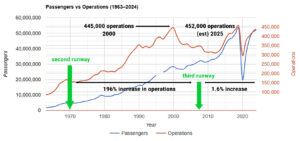
In our last episode (This Will Never End), we talked about a stat most people miss: 1.6%. Although passengers have more than doubled, over the past 25 years, flights have only increased 1.6%. The airport obsesses over passengers because passengers are money. They talk far less about operations because that is the noise and pollution.
This time, we talk about another cognitive disconnect: property values vs. affordability, aka ‘the airport discount’.
Over the years, many people concerned about airport impacts have complained that their property values have been reduced by the airport. That’s not a bug, it’s a feature. The invisible hand of the free market has indeed priced your home lower than it would otherwise be if it were somewhere far away from the airport.
Unlike much of the world, Americans use the homes not only as places to live, but also as their primary store of wealth. So, anything that seems to hurt our property values is a direct attack on us.
But as the King County Tax Assessor told us: So what? Doesn’t that mean more affordable homes? Doesn’t it mean lower taxes for homeowners?
‘Lower property values’ have been seen as proxies for trying to stop airport expansion–or getting a check so individuals can go somewhere else. Most of these efforts have been either unsuccessful or unsatisfying.
But by analyzing property data we have been able to begin researching something important: how to quantify what ‘the airport discount’ means not for individuals, but for cities.
The Sea-Tac Communities Plan (1973-1976) was the only time in our airport’s history where the impact on communities was really taken seriously. In all other cases, the focus has been on individuals. The entire Part 150 program concerns individual parcels; not cities. The Port constantly talks about benefits for jobs. What hasn’t happened since 1976 has been a frank acknowledgement of what the airport is doing to local governments.
Early on, the City of SeaTac did begin negotiating ongoing compensation. But other cities became convinced that (somehow) the airport would create economic development–organically. That does not happen. In fact, the airport discount drains the life blood of the communities nearest the airport. The benefits are really, but almost in inverse proportion to distance from the flight path.
The biggest challenge in obtaining a fair reckoning has been the cities (and residents) themselves. Neither group has understood why it’s just as important to compensate their city as themselves to improve everyone’s quality of life.
 We also want to acknowledge the passing of a true heroine for airport communities: noise researcher and advocate Arline Bronzaft.
1981 Professional Air Traffic Controllers Organization strike – Wikipedia
FAA SEA Airport Capacity Profile 2018
Annual Operations and Passengers
SAMP Draft EA Appendix A Forecast and Operational Assumptions
To learn how you can make a difference, read our STNI: 2026 Legislative Agenda and
- STNI.info/subscribe
- Video feed
- Find us on all the best podcasts, including Apple and Spotify, or subscribe via SSAppleSpotifyYoutube