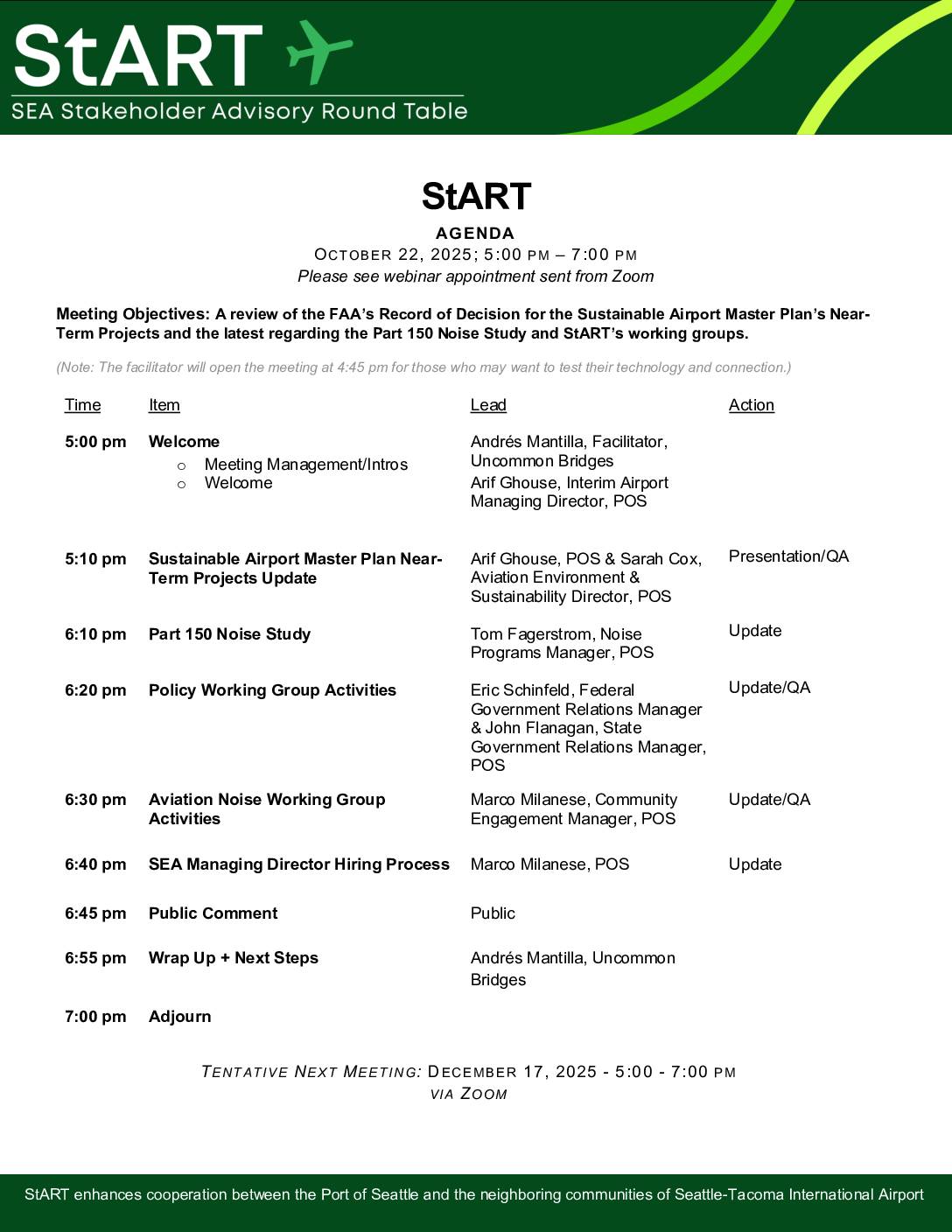
StART Meeting Agenda October 22, 2025
SAMP NTP Final NEPA EA, FAA Record of Decision, and SEPA Next Steps Presentation 10-22-25
machine-generatedOPENING REMARKS
**Andreas Mantilla (Facilitator, Uncommon Bridges):** As we begin always welcome, good to see you all. My name is Andreas and I don’t think we have anybody new at this point, but I’m joined by my colleague Cheryl Swab going to be taking notes. Our Zoom facilitation platform is a zoom webinar style. That means that StART members and guest speakers are the panelists. They can speak during the meetings can chat with us any sort of guest speaker and leave port staff. We have observers or attendees. Right now we have six on the meeting that can speak sorry that can see presenters and presentation materials but aren’t visible to StART members or presenters unless they’re giving public comment at which point then I will bring them over to public comment. Our StART member roster hear me?
**Jeff:** Yep, we can hear you now, Jeff. Thank you.
**Andreas Mantilla:** Yep. Our StART member roster is here. Only StART members and presenters are invited to speak during the agenda topics. Please use the zoom hand raised function or the chat if you want to get my attention. Do a pretty good job of making sure that we’re tracking both our expectations and ground rules. Participate focus on the subject at hand. Represent your constituency. Respect diverse views and communicate fairly. We want to participate fully, honestly and fairly. We want to speak respectfully. We want to keep an open mind, acknowledge all participants and allow each other people to share without fear of criticism. And then our facilitation ground rules are around neutrality, transparency, clarity. We’ll make sure each voice is heard. We’ll begin and end on time and have clear follow-up. Today in particular, we have a pretty full agenda. So, if folks are if we’re kind of I’m checking in on time, I might ask us to move along and then have folks follow up via email.
Okay. A reminder that if folks want to record meetings, anyone who wishes to audio or video record a meeting, they are required to notify the facilitator, Cheryl or myself, prior to beginning the recording. StART meetings will not be officially audio or video recorded. Any recordings by participants or members of the public are not considered official or necessarily accurate recordings of the meeting. We don’t have any requests for recording today. And I’ll turn it over to Arif for some opening comments.
**SUSTAINABLE AIRPORT MASTER PLAN PRESENTATION**
**Arif Ghouse (Interim Airport Managing Director, Port of Seattle):** Yes, thank you. Good evening again Arif Ghouse, Interim Managing Director at Port of Seattle. I actually just wanted to get into the SAMP if that’s okay with you. But welcome. Thank you for being here and purpose of today I was just going to give you some background on the SAMP and then have Sarah our director of environment and sustainability go into some of the more technical stuff. But before I do that, I just wanted to just say that purpose of today is to do just that to give you some background and going dive into a little bit of how the FAA arrived at its decision etc. We’re in the appeal process right now, the period with this with the NEPA and so we not intending today to be a kind of a comment session that’s already taken place with the EPA and NEPA period that was open. So today is really more a briefing on where things stand. So again thank you for the opportunity to provide an update on the status of the sustainable airport master plan near-term projects or as we like to refer to it SAMP NTP. The development and the environmental review of SAMP NTP has been almost a decade now in the works at this point and we have much more work to do before there’s a final decision on the way forward and so our goal today is to make sure you understand what the SAMP NTP are where they came from what they proposed to accomplish and what the next steps are.
To begin with the headline, the FAA completed its federal environmental review through the National Environmental Policy Act or NEPA. They released their final EA finding of no significant impact and record of decision or as we refer to it FONSI ROD on September 26 of this year which found that the 31 SAMP would not have a significant environmental impact once all the required mitigation has been done. Now this conclusion may be surprising to members of the community who are concerned about aircraft noise and emissions and one of the key points of this presentation is to help everyone understand what NEPA looked at and how FAA came to this conclusion. Just as important we will talk about how NEPA environmental review is only one step in the process and that the port will now take the lead on conducting an environmental review using the state environmental policy act or SEPA. But before we do that, I wanted to make sure you understand how we got here and why.
In 2010, SEA airport served approximately 31 million annual passengers. In 2019, we served around 52 million passengers. That’s 31 to 52 million in just 9 years. There are several reasons for this significant increase, but the most tangible one is the economic and population growth of the Puget Sound region. The more people who live here and do business here, the more that people want to fly in and out of the region for business, tourism, leisure and to see family and friends. Now, as you can see from this chart and for reference on the left side we have the population of the central sound Puget area in million and on the bottom we have a timeline in years and on the right we have the total number of passengers passing through the airport in millions.
So as you can see from the chart, air demand and regional growth have a clear relationship and importantly we project that this relationship will continue in the future as increased growth drives increased demand for the next decade and I apologize for those people who are whoever is forwarding slides I haven’t kind of like prompted you to do that. So if you could go to the next slide please. However, while we keep seeing increased demand for air travel, SEA airport is one of the most, if not the most constrained major airport in the country surrounded by cities and highways, we can’t further expand, which means that we have to accommodate all future growth in our current footprint. And let me be clear, under federal law, we cannot deny air service. And so barring the development of another regional airport or a change in air travel demand, we must be prepared to accommodate future projected air traffic travel within our facilities. And we have seen over the past decade what that can mean to what that means for our current airport. Increase the increasing congestion and declining customer experience while people wait in traffic in long security lines in crowded hold rooms or even less pleasant getting on and off the aeroplane from a remote hot stand because there are no gates available. Next slide please.
Just to demonstrate how constrained we are, here is the Atlanta airport in red and then here is SEA in blue. Obviously, we’re significantly smaller, but even more impressive is the fact that Atlanta is only processing twice as many passengers as us at way more than twice the size, which means that SEA is actually pretty efficient in it small but mighty footprint. Next slide, please.
Of course, one person’s efficiency is another person’s terrible airport experience. Our goal is not only to make SEA work but also make it comfortable for our travelers. Which means that we do not want to be squeezing more and more air service into our constraint facility. Without additional investments, SEA will see increasingly worse conditions, more delays, longer lines, more congestion, not only at the airport itself, but also more traffic on the roadways in nearby cities and more planes circling overhead while waiting for their chance to land, which will lead to extra aircraft emissions and noise. Next slide, please.
And so we started to plan looking at dozens of different options for ways that we could design and or renovate our passenger and gate facilities to meet air demand in an acceptable way. It was a very involved process and we worked hard to identify the best, most efficient and most sustainable option. What you would see here are many of the different layouts that we looked at to address the passenger terminal needs. Next slide, please.
The result is the 31 projects that we are proposing which include a second standalone terminal, passenger terminal and 19 additional gates. We believe that this proposal works best to accommodate growing air travel demand at the airport and also updates our facilities to meet operational need. The new terminal is necessary not just because of the 19 gates, but also because it allows the airport to add new roadways, more parking, additional curbside, more TSA lanes, and more excuse me, dining and retail. All of the things that will allow the airport to continue to work when it reaches 56 million passengers or more.
Next slide, please. Of course, the SAMP NTP are more than just a terminal. These key projects span the footprint of the airport from the offsite cargo to the north and in this drawing over here northeast to our to the right to an expansion of the fuel farm in the south. In addition to these those three, you can see at the bottom of the slide some of the most impactful projects in the plan, including a new ground transportation center on the bottom left to make to better connect the light rail stop to the terminal, as well as an elevated guideway shown here in a dotted black line that will connect the main terminal, the new terminal, and the existing rental car facility.
Next slide, please. Once the planning for these projects was completed, we then turned our attention to the environmental review. So with that, let me turn things over to Sarah, our director of environmental and sustainability at SEA, whose team led the port’s work with the FAA on the NEPA process.
**Sarah Cox (Aviation Environment & Sustainability Director, Port of Seattle):** Thank you, Arif. Good good I almost said good morning. It’s been a day. Good evening. And I really appreciate the opportunity to connect with you tonight on the FAA’s environmental review and our upcoming work with the state environmental policy act or SEPA process and next steps. So, I just wanted to touch base on the environmental review process just to level set. So the purpose of an environmental review is to assess potential impacts of a proposed project or program. And related to SAMP, the FAA assessed the 31 projects that Arif mentioned. For the environmental assessment, the FAA analyzed resource categories under the NEPA regulations and special purpose laws. The 31 projects were all evaluated for potential impacts related to air quality, biological resources, land use, historical resources, hazardous materials, and other categories. If impacts were identified, the analysis evaluated the extent of those impacts and if required identified ways to avoid, minimize, and mitigate those impacts. Next slide please.
Is it popping up on your end? My my screen. Sorry. One second. No, that’s have to reshare. I’m not sure what quite what happened. Great. Thank you.
And as many and you are already aware that FAA is a lead on the NEPA process and the port is the is the project sponsor and FAA completed an environmental assessment. Once we move into the SEPA process the port will be the lead agency and I am the responsible official for the airport under SEPA and in the SEPA process the port will be conducting a SEPA environmental impact statement. Next slide please.
So as one of the first steps in NEPA, it’s to identify the purpose and need of the projects. And the NEPA documentation identified five primary purposes and needs to accommodate 56 million annual passengers at an optimal level of service. Accommodate the projected cargo demand. Ensure that the airfield infrastructure meets FAA airport design standards. Enhance the efficiency of the overall taxiway layout and meet our projected fuel storage demand which includes space for sustainable aviation fuels. Next slide please.
And as Arif mentioned previously, the growth in the regional economy and population coupled with a lack of another commercial airport in our region means that SEA is a main receptacle for increased Puget Sound commercial air travel. And this slide historically you may have seen it in a table. We tried to provide another method of referencing it. But this slide shows the anticipated growth of passengers and operations at SEA in the 2032 and 2037 with and without the near-term projects. So 2032 is the year the near-term projects are anticipated to be completed and substantial or substantially complete. And for the purposes of environmental review, we also look five years beyond that and conduct analysis on the anticipated operational year.
So it’s also important to note that with or without the near-term projects, passenger and operations will continue to increase. As you can see on the left is the total passengers and in blue and in the green is the airport operations and what that looks like. If we are the no action if we are not to move forward with the projects and the proposed action for both 2032 and 2037. And within that you can see that passenger and operations continue to increase whether or not we move forward with the near-term projects. As we have already seen airlines they find another way to put another person on a plane upgage the aircraft or change their schedules.
And these numbers they’re really important for the environmental review. They’re the basis for the analysis and how potential impacts are identified. And because passengers and operational volumes will continue to grow with or without the near-term projects, the difference between the future projects and operational volumes is minor. And this is one of the reasons why the significant noise and air quality impacts were not identified in the environmental review. Next slide please.
And the environmental review looked at three alternatives. These alternatives were derived from the planning, the environmental review itself and comments that we received during NEPA and SEPA scoping. The three alternatives were a no action scenario. So, if we don’t build the near-term projects, the proposed action, which the 31 near-term projects, Arif described earlier, and a hybrid terminal option that was identified in the scoping process. And this hybrid terminal option connects existing concourse to the proposed north gates and terminal. And all three of these alternatives were fully evaluated with the environmental assessment with the proposed action being the alternative that best meets the current and future needs at SEA. Next slide please.
So during the draft NEPA EA which was released by FAA on October 21st of 2024 just a year ago all the resource categories identified in this slide were analyzed in the draft EA including cumulative impacts. Surface transportation, as you can see on the top, was the only resource category that identified significant impacts that would require mitigation. While other less significant impacts were identified, they were not identified as significant because they were below regulatory standards or the port is already implementing programs in place or has programs in place that minimize these impacts. Next slide, please.
So, in the release of the draft environmental assessment, it initiated the comment period and as you’re aware, the FAA extended the comment the public comment period twice as a result from many of your interests and feedback, a request from the port and the Thanksgiving holiday. And that was for a total of 53 days. This included robust public outreach and engagement and included four open houses with over 230 individuals attending, 42 community presentations conducted by port staff and many other approaches to ensure a broad outreach to the community which included over 10,000 mailers to publishing documents in multiple languages. Next slide, please.
So, as a result of that public comment period, the FAA received 591 comment letters which included 2554 unique comments. And so, for example, that one letter could have had 10 unique comments. And so, why that’s why those numbers look different. So on this slide you can see the general themes that were identified ranging from a request to complete a NEPA EIS request for additional analyses and build a new airport. FAA reviewed every comment and responded to each of these comments and the response to those comments were included in the final EA in appendix O of the environmental assessment. The document is available online at the project’s website and also it’s available in the Highline city libraries and I’ll put a link following the presentation to the section of the site where that appendix is located. Thank you.
And so during the final EA FAA there were a few items changed and FAA issued the final environmental assessment and you might hear it called FEA. That’s just the abbreviation for it. So that was released on September 26th. The comments received didn’t warrant any changes to the analysis between the draft and the final environmental assessment. And because no significant impacts were identified that could not be mitigated, the FAA did not conduct a NEPA environmental impact statement. However, in the final environmental assessment, there were changes in three areas: climate, environmental justice, and cumulative impacts. And these were removed because of the regulatory changes by the Trump administration.
And I just really wanted to highlight that these elements were removed since a publication as a result in changes of executive orders and the Council on Environmental Quality or CEQ as it’s more often referenced to changes in the CEQ do to be able to respond to those new executive orders. And in the response to comments, it identifies all of the executive orders that were revoked and the issuance of new executive orders and to reflect why those changes occurred. I do really want to I want to emphasize though that in the draft environmental assessment all three of these topics underwent robust analysis and none of the resource categories identified significant impacts even though they were removed from that final environmental assessment. The information still available in the draft EA which is still available on our web page. So I just want to make sure that everyone is aware that that information is still available. Next slide please.
So just to underscore that point because I know there was some questions that we received. There was a plan with the draft. Yay. And because of some changes from the Trump administration and the FAA determination of those changes, these things were stricken and not considered in the final.
**Participant:** Correct. Correct.
**Sarah Cox:** Jeff, sorry, Andreas, I jumped in there.
**Andreas Mantilla:** No. Yeah. Go ahead. Go ahead, Jeff and Katherine.
**Jeff:** Yeah. You said that these things had undergone extensive analysis. I don’t know if that was your term and but I’d point you to general response 9b on the ultrafine particles where it says UFPs were not included as part of the air quality analysis given the existence science on UFPs including the University of Washington mobile observations of ultrafine particles move study is not fully mature and the measurement and understanding of UFPs and their related health risks have not been clearly defined. That is an opinion. Whose is it? This is the response by FAA on that.
**Sarah Cox:** Yes. So this is this is the FAA’s opinion based on what do we have any idea? It is primarily because there are not any regulatory requirements for ultra fine particles at this time and so they don’t have they don’t have any of the criteria to analyze and evaluate against.
**Jeff:** Well, nobody here is saying they don’t have an impact. We just you don’t have to do it. And it’s and it’s and it’s FAA just to underscore it’s the FAA determination and opinion that’s I would like to hear Sarah’s response not yeah and I will get there in a second I’m trying to I’m trying for because different people are at different areas of understanding Jeff you know this very well others might not trying to summarize and then we can hear from Sarah and so these are FAA interpretations of these comments and therefore the their opinions.
**Andreas Mantilla:** Yeah. Go ahead, Sarah.
**Sarah Cox:** Yeah. And it’s and it’s wasn’t included because it’s just it’s not a requirement under NEPA or the FAA’s NEPA framework.
**Andreas Mantilla:** Thank you. Okay. Katherine and then Roger and then Brandon.
**Katherine:** Thanks. I have two questions. So, my first one is I appreciate that you Sarah really, you know, put up there here are the parts that we had to take out, you know, due to I guess the executive orders being pulled back and other decisions by the Trump Organization. I know you and I talked about this at the part 150 hearing as well. This is going to sound like a loaded question, but it’s actually not meant to be. It’s a real question. I think I am struggling with understanding whether it’s from the port’s perspective or FAA because they seem to sort of get intermingled sometimes the decision to like for lack of a better word comply with the Trump organization and the the you know directives from the federal government when it relates to two portions of this report that you know are like very important to this group. Absolutely. But then in the next day, all I keep reading about in the paper and on the news is how I don’t know if it’s the port or the FAA, they just said the airport like is not going to show some video the Secretary of Homeland Security wants all the airports to show because it doesn’t align with their values. And I can appreciate that decision, but it’s frustrating that on one hand, I see you all kind of pushing back against the federal government, but then on something that is like very significant to our communities, it looks like there’s just compliance. Can you I don’t know if you can answer it, but if you could, I’d like to kind of understand that differentiation.
**Sarah Cox:** Yeah. And and because NEPA is administered by the FAA, the federal agency, they are following the federal executive orders and and so that so under this NEPA document that is why environmental justice or these these three categories were removed under SEPA which we have the port has control over and I’ll be noting that earlier we are including environmental justice and cumulative impacts in our SEPA analysis
**Katherine:** Does did I answer that yeah I mean that’s going to be my follow-up question is like can you give us assurances that the subjects that are really important are going to be included SEPA you said yes which I appreciate and for what it’s worth I’m saying I’m frustrated that there’s this very visible push back to the federal government on a video. Yes. But compliance on this, but thank you for answering.
**Sarah Cox:** Yeah. And this is FAA’s document that that they release and and once we get into SEPA or excuse me, SEPA, which is our control document, we’ll be able to include those resource categories. I’m gonna go quickly to Eric to answer that second part of that question and then we’ll go to Roger, Brandon, and Joe.
**Eric Schinfeld:** Yeah. Well, I I think I I think Sarah just said it well, which is that we don’t get to tell the FAA what to put in their documents, and the TSA doesn’t get to tell us. Oh, Eric, I think you cut out their Oh, sorry. Can Can you hear me? Can you hear me now?
**Andreas Mantilla:** Yes. Start over, Eric.
**Eric Schinfeld:** Yeah. Sorry. Sorry, apologies. Apologies for that. I was just saying that I think well in that we don’t get to tell the FAA what to put in their document just like the TSA can’t tell us what to show on our TV screens. And so it really is about whose thing it is. The the NEPA document is the FAA’s. We don’t get to tell them what to put in or not. And our our monitors are ours to control and we get to tell the TSA we’re not going to show this video. So again, sort of it’s that sort of who has control over what. We do have control over some things that happened at our airport. We are pushing back against the Trump administration in many ways. We’re suing them to stop them from denying us grants based on our DEI programs, things of that nature. But like Sarah said, the NEPA document is not something we get to push back on because it’s not our document. What we have control over is a SEPA document and that will look very different in in significant ways.
**Katherine:** Okay. Can I just make I’m sorry, Andreas, then I know you need to move on. Can I just make Yeah, yeah, go ahead. Go So I think there is definitely some confusion at least amongst some of the cities about whether or not this will be included because of comments that were made about how the SEPA the SEPA process will be using substantially like similar documents or the same data. There’s some comment made in that Zoom meeting you all had about the EA and so I think that’s caused a lot of concern. So it might be good unless I missed it like to really get that distinction out. just because of that comment that we were going to you guys were going to be using the same data.
**Sarah Cox:** Yeah, I I can just respond to that. There’s just there’s foundational data and analyses that like for example the noise the noise monitor or analysis that analysis we will use as the foundation of what was done in NEPA. Same with the air quality. We will continue to use that foundational, but we’re going in air quality, we’re going to be taking that a step further. So, I would I would say it will be NEPA plus under SEPA if that if that helps clarify that.
**Katherine:** Thank you.
**Andreas Mantilla:** So, Sarah, if I can just add a quick comment to that, Eric just posted I was going to say the same thing. Sarah’s going to get into the the SEPA side of it. So, you may answer some of your questions. And the other thing, you know, Sarah’s team is a lot more intelligent than me, smart people who understand the technical stuff way better than I do. But, and Sarah, you correct me if I’m wrong, but I understand the draft EA did include some of these components before the executive order required the federal government to take out some of those. So, that analysis was done and that data is available to the team that we can then tap into to help build the SEPA. But beyond that as well, our team is looking at adding other components because we we again to follow the values of our region and everything. So just wanted to add that component there. Thanks Charles. Okay, Roger then Brandon then Joe.
**Roger:** Thank you. I had a couple of questions and comment. First of all I was planning a sort of comment right at the end but since people interrupted I I’m going to throw it out now. I was concerned about a statement that Arif made in in his analysis setup for the presentation. Did I understand that correctly that you say you must accept the airport traffic by statute?
**Andreas Mantilla:** Go ahead Arif.
**Arif Ghouse:** Yeah. So thanks for the question. What I was stating there was if an airline wants to bring in a flight to SEA, we cannot deny them. We don’t have the authority to say you cannot add a flight at a destination. Right? That’s between the airline and the federal government in terms of approvals they get to fly here. And if it’s an international flight, customs has to give them approval to land to to to process the passengers as international. So we as a port authority cannot deny an airline from bringing in a flight.
**Roger:** So so from a practical or common sense standpoint, what happens when you know physically we can’t do it? I mean the graphs you showed show that even with the the the projects proposed we’re going to exceed capacity. So so what do we do? That’s the worry, right? So, I mean, airlines, if they can get more flights in here because they’re in they’re they’re a private company and and they wish to do that, then it’s going to mean the planes holding on the airfield longer once they land, waiting for a gate to free up. or you know and it it it would mean more congestion on the public side of the terminal on the roads getting in through the checkpoint because more people will be signing up for those flights potentially and trying to squeeze through a constrained environment. And then I think I also touched on this in my presentation about the impact on a roadway system in the cities and also planes having to go into a holding pattern waiting for their permission to land because there’s not a either capacity to land at that time or there’s no gate available for them.
**Roger:** Well, which leads me to my next question. In point of fact, isn’t the reality that we’re going to push push a lot of the services we get now to Portland that literally the airlines are going to cease to use SEA because they can’t be serviced.
**Arif Ghouse:** Yeah. I I I don’t want to speak on behalf of Alaska Airlines, but I think what you may be referring to is media reports about them saying they may absolutely make strategic decisions to move certain flights to Portland to so that they can cater to a different kind of market from the SEA area, SEA area, which yeah, which again will hurt business here because we we will no longer be able to serve the businesses that are demanding the flights.
**Roger:** That’s that’s one aspect. Now, a completely different aspect that I wanted to ask probably Sarah about is the the the condition the conditions that must be adhered to. One of the concerns and and this goes directly to Jeff’s comment. the a lot of the areas that we have the most concern about do not have current or updated statutes or enforcement criteria levels. For example, and the nano particles or the ultrafines was was pointed out as one. So in point of fact, we go through this entire process. we identify areas of concern and yet we blow it all off because there hasn’t been an established regulatory parameter. I’m thinking not only of the air quality but also the water quality and the salmonage and the work that the UW has done in trying to restore salmon runs and they’ve identified the concern is highly specific toxins that are associated with tire rubber which the airport loads heavily into the streams but they don’t even monitor for it. Yeah. So those are kinds of issues that are of real concern that point to reality that common sense wise I’m concerned that we’re not even looking at. But I understand why because there’s no regulatory criteria. You need to make that clear to the public because the public will think that you’re blowing stuff off. You’re not. You just don’t have any criteria to do it.
**Andreas Mantilla:** Roger. Before Sarah responds, I want to note that we we’ll go to Brandon and Joe and then I’m going to move us forward. If folks have additional questions, let’s let’s continue through the presentation and then we can kind of cycle back at the end. But go ahead, Sarah.
**Sarah Cox:** Yeah, Roger. And I I I think that’s one of the reasons like we often talk about programs that we implement versus what is in a regulatory process and for example what you mentioned with the emerging tire dust pollutant. We have been engaged with ecology UW on on this topic and understanding you know what best management practices are the best to be able to treat that. Unfortunately for all of our infield areas, we’re currently using the best management practice that they’re recommending for that and looking at what other you know areas to potentially retrofit to make sure we’re doing that. So I think that’s one of those things that there’s a lot of programs that we implement that aren’t highlighted because they’re not part of a regulatory process. But we have been proactive in implementing.
**Andreas Mantilla:** Great. Thank you Brandon then Joe and then we’ll get back into the presentation.
Brandon: Thank you. I want to focus on the equity analysis and equity analysis and I’m glad you know that Sarah mentioned that they’re going to include equity analysis in SEPA. But I want to be really clear about something. The Port of Seattle as a government entity can choose to to exceed requirements. They can choose to go above and beyond what is required by a SEPA analysis. It’s just like when you build things for an earthquake, you can beat the meet the building code or you can exceed the standard. And so I’m really hoping that the port will go and say we’re not going to just do this under SEPA. We’re going to do an equity analysis that exceeds even what we would have to do under a SEPA review because I’m worried that the port is anchoring this entire process and this entire review to say if it’s SEPA compliant then we don’t have to do anything else. And I hope that’s not I mean this statement here is a great statement related to equity. So I would ask that the port lead with this example related to equity.
Sarah Cox: Yeah, you bring up a really good point and I I think there is the regular regulatory structure and then the programs and our currently our EDI program we have an equity index. We’re looking at we’re coordinating with and how we apply that equity index both within environmental review process and then on our programs and our operations in general. So I do really appreciate that comment.
Andreas Mantilla: Great. I’m going to go to the chat here and then and then Joe, you’ll go next. A comment from where what is the LOS for air service at SEA? And then the NEPA consider the impact of not relocating cargo thereby encouraging locate elsewhere.
Arif Ghouse: Yeah. Arif, do you want to talk about IATA and how the level of service is defined? Yeah, I mean there’s two main industry benchmarks that airport are based on. One is called kind of a star rating, right? So we are fourstar airport. It goes up to five star and then there’s what’s called the ASQs airport quality and that’s done through metrics from the airport council international which is a worldwide kind of body and so it’s based on optimum level of service what that criteria is and how we meeting those against the criteria that they’re based. So, and and those, you know, scores can be all over the map depending on what kind of facility you are, how constrained you are. But I I do want to note that I I’m sorry, I had to look it up because I get so used with the acronym international air transport transport association. So it it identifies from from the drives to the whole cradle to grave approach passenger experience, how long it should take you to drive into the airport, what is an optimal amount of people at to get through ticketing through your security lines. And so that’s how that optimal level of service is defined. It’s based on that IATA standard and criteria connection time between flights etc.
And a second part of that question did the NEPA consider the impact of not relocating cargo thereby encouraging it to locate elsewhere. I do just want to mention I I can’t remember the exact number but I believe it’s over 50% of the cargo is actually in the belly of passenger aircraft. I don’t know if you know that exact number but so so a large percentage of our cargo is through the passenger the belly of the passenger aircraft. Was I on point with that number?
Speaker: Yeah. Yeah. Yeah. A significant portion is moved through the belly cargo and then we have all cargo freighters as well. But NEPA is looking at proposed projects right in terms of the level of service and everything. I don’t think any of the projects specifically call for moving cargo completely out of SEA. that really yeah I don’t I don’t believe Sarah that was a no it’s it’s looking at what it’s looking at what the forecasted demand is of cargo at SEA and the facilities needed to accommodate that.
Andreas Mantilla: Okay. We’re going to do about 10 more minutes of questions here and then we’re going to move on. So, Joe, and then I’m going to kind of go back and forth between the comments in the chat as well. So, go ahead, Joe.
Joe: Question for Sarah. You mentioned earlier there was a specific list of transportation projects and, totaling about $40 million. And where does that funding come from? Is that airport revenues? Is it bonding? Is it federal money? Where does that Who pays for those?
Sarah Cox: It would be airport funded. Because when the trigger for that mitigation is when the first transportation project that’s identified in the NEPA starts. That is when we would have to begin the mitigation for the surface transportation.
Joe: It’s not tax levy. That’s it’s not tax levy. It’s just operating. Okay. And then a quick hypothetical. You mentioned that you routinely monitor some hazardous waste components of the of your storm water and you report that to the FAA. What happens if the FAA calls you up and says, you know, we’re closing that office. You don’t have to report anymore. Do you continue are are you do you have any obligation to continue monitoring those things or or does that go away when the FAA if the FAA goes away?
Sarah Cox: Yeah. I I just want to clarify it’s not a hazardous waste. It’s just it’s a storm water pollutant. Yeah. Most of currently all of the requirements we would report through the department of ecology. For 6 PPDQ we currently don’t report. There’s we don’t have a reporting requirement under our permit. However, ecology is currently developing monitoring for for that parameter.
Joe: Okay. Okay. So it so it could survive. Yeah. Thank you.
Andreas Mantilla: Thanks, Joe. Question from Jeff in the chat and then I’ll go there and then we’ll go to Roger and wrap things up. What does proportionate mean? I think there was a on the 40 million surface transportation mitigation identified slide slide 20. You mentioned you use the word proportionate. Jeff, I’ll turn it over to you can ask the question. And we have about five or six more minutes here.
Jeff: You said you were going to turn it over to me. Did you mean go ahead if you want to ask the if you want to ask the proportionate question yourself and if you I think I know what it means. It just means that the cities have to pay some part of the cost of that. Is that right? Or WSDOT.
Sarah Cox: Yeah. So there’s a combination depending on which the entity is.
Jeff: That’s what I thought. Thank you. But that would have been part of improvements that were already planned by the jurisdiction.
Andreas Mantilla: Great. And then a question from Roger in the chat. To date, are you aware of any persons, entities that have appealed the FAA NEPA finding? If so, does this impact the SEPA process and/or schedule?
Sarah Cox: I’m I am not aware if there have been any filings to date with respect to SEPA. Currently we’re continuing to move forward with the SEPA process. And you know we’ll continue to to monitor the federal appeal process.
Andreas Mantilla: Okay. Thank you, Sarah. Any other any other questions?
Jeff: Yeah, Jeff, go ahead. I’ll try and make it quick. Sarah, thank you for doing this. It’s hard to be sitting there and take the some of this. What does cumulative impact mean for the purposes of SEPA? that the scope for that.
Sarah Cox: So, we’re still developing parts of those scopes and so I don’t have an answer for you right now on exactly what that that looks like. So so so more to come on on that item. I don’t have I don’t have an exact answer at this time.
Jeff: And cumulative impact or would it include particles even if they’re not required by the FAA to be managed or to be included
Sarah Cox: There has not the scope for the air quality is also under under draft right now and review and development. I I will say that we are including a dispersion modeling under the air quality and so that we have been working with the Puget Sound Clean Air Agency on the criteria and parameters in the dispersion model and we’ll be following up with them as we refine that and before we start the analysis.
Jeff: Well, given the growth you’re expecting and what we already know, I I do hope that that’s included. And now I’ll be quiet, Andreas. I don’t want to get you off schedule.
Andreas Mantilla: No, thanks, Jeff. We got we got some more to go here. So, thank you, Sarah. Really appreciate that update and more to come as we continue to monitor that. I’m going to move us along and I’ll invite Tom to come on camera and take us through the part 150 noise study.
PART 150 NOISE STUDY UPDATE
Tom Fagerstrom (Noise Programs Manager, Port of Seattle): Okay, thanks Andreas. Yeah, I’m Tom Fagerstrom. I’m with the Port of Seattle’s noise office. As many of you know, I’m the project lead for the part 150, the ongoing part 150 noise study. And so, this is just a a bit of a a quick update on where the the study stands right now. The study was kicked off last year with a series of public workshops that kind of explained the process and and and also explained what was to come with part 150 and and so this year the study team went to work to develop the noise contour maps, the noise exposure maps and that was released to the public for their review. And those maps by the way are available to review at our website which I’ll refer to quite often here as SEApart150.com.
We also began work on some preliminary land use within those noise contours. Some preliminary land use data. We also met with a few of the local cities to talk about land use. And so we just completed a series of public workshops. Three of them were in person in Des Moines, Burien and SeaTac and then one virtual public workshop last week last Wednesday in fact and a total of I can report that a total of 85 attendees attended these events. Comments to the study team were encouraged. To date we’ve received 31 comments as a result of those those meetings.
And and really the the meetings had two purposes I would say to talk about the noise exposure maps that were released particularly the 2032 future year contour that will be the basis for our our updated noise remedy boundary once it’s approved by the FAA. And to talk about land use, some of the preliminary land uses within that contour, but also to transition to the next phase of the part 150, which is the noise compatibility program phase. And that’s where we since we have impacted areas now, what measures can we propose to to do to mitigate those those those impacts? And so we are kind of finishing up the noise exposure maps phase. Right now, we have a draft noise exposure maps report that’s in development right now. We expect to get that draft noise exposure maps report out to the community for review later this fall likely in November.
And then that report will be developed and then submitted to the FAA for their approval in the spring of 2026. and that’s when those noise exposure maps will be approved by the FAA. The schedule for part 150 to to come is I mentioned the the the NEM report approval in the spring of 2026. And and really starting right now is we’re starting that noise compatibility program phase of the part 150 where we start to take those comments that we’ve received and and start to come up with a proposed analysis proposed measures that could be included in a noise compatibility program.
And that will talking back about schedule again in the fall of 2026, we’ll have another round of public workshops. We’ll talk about some of those proposed noise compatibility program measures and measures as we talked about at the workshops can be measures that limit noise that that change how aircraft are operating. The measures can also include mitigation measures such as sound insulation programs. So our schedule continues. We anticipate getting a draft final part 150 report to the FAA to the to the public for review in 2027 and then late 2027 to get FAA approval of that final part 150 report that’ll include the noise exposure maps and the noise compatibility program measures. And at that time we’ll have an updated noise remedy boundary based on that future 2032 65DNL contour. So that’s really where we are at with with part 150.
Andreas Mantilla: Great. Thank you, Tom. Any questions for Tom before we move on to our policy working group update?
POLICY WORKING GROUP UPDATE
Eric Schinfeld (Federal Government Relations Manager, Port of Seattle): Thank you. I’ll provide an update on our federal policy and advocacy efforts. On the federal level, we continue to monitor and advocate on several key issues affecting the airport and our region. Infrastructure funding remains a top priority. We’re actively tracking implementation of the Infrastructure Investment and Jobs Act and ensuring SeaTac receives its fair share of federal aviation funding for critical infrastructure improvements. We’re also monitoring the upcoming FAA reauthorization process and advocating for provisions that support airport infrastructure investment and noise mitigation programs.
We continue to work closely with our congressional delegation on airport-specific issues. Senator Murray and Senator Cantwell have been strong advocates for SeaTac and we maintain regular communication with their offices on emerging issues. Representative Smith has also been very supportive of airport interests in her role on the Transportation and Infrastructure Committee. On the regulatory front, we’re monitoring several FAA rulemaking processes that could affect airport operations, including updates to airport design standards, noise certification requirements, and environmental review processes. We provide input on these rulemakings to ensure they consider the unique challenges facing constrained airports like SeaTac.
We’re also tracking federal policy developments related to sustainable aviation fuels, which ties into our SAMP planning for expanded fuel storage capability. The federal government has set ambitious targets for SAF production and use, and we want to ensure SeaTac is positioned to support these initiatives.
Katherine: Eric, I have a question about the federal funding for Part 150. You know, are we going to see are we are we in line to get any of that funding? And how much federal funding could we potentially see?
Eric Schinfeld: Yeah, that’s a that’s a great question, Katherine. And and really Tom can probably speak to this better than I can in terms of the technical aspects of Part 150 funding. But you know, the the general answer is yes, Part 150 studies, once they’re approved by FAA, do make airports eligible for federal funding to implement approved noise compatibility measures. The amount of funding varies significantly based on what measures are approved and what the federal budget looks like in any given year. But it can be substantial. Tom, do you want to add anything to that?
Tom Fagerstrom: Yeah, just to add that once we have an approved Part 150 study, we become eligible for what’s called the Airport Improvement Program or AIP funding for noise compatibility measures. That could include things like sound insulation programs, land acquisition, noise barriers, operational improvements. The exact amount depends on what measures are approved and what funding is available, but it can be significant federal assistance.
Katherine: And and are we expecting that we would get the funding or is this a competitive process?
Eric Schinfeld: It is competitive to some extent, but airports with approved Part 150 studies are in a much stronger position. Having that federal approval really helps in the funding process.
Katherine: Absolutely. And and let me just say that you know this is a question asked to Sarah earlier as well during the SAMP presentation about how we think about programs over and above our regulatory requirements. And I won’t speak for our five commissioners other than to say that they are pushing us really hard to think about all the different ways that we can do more to address community concerns. So, I appreciate the concern, Katherine. I can give you my honest opinion for what it’s worth as not a commissioner or even a important person at the port. is that this would not be this would not be instead of the port continuing to lean into doing as much as possible. Frankly, more federal funding makes it easier for us because these are always required match and so we would have to come up with additional dollars to match these funds. So, always continue to push us to spend more of our own money to do what you want us to do. But federal money helps us do even more.
Katherine: Got it. Thanks, Eric.
Eric Schinfeld: Thank you, Eric. And then I think we’re going to Anything else you want to say, Eric? You can move move forward.
John Flanagan (State Government Relations Manager, Port of Seattle): folks, hear me? Okay. Good evening everyone. Per Eric’s remarks about changes and trying to track different versions of our state legislative agenda. Feedback we received mainly at the policy working group was regarding what would have been agenda item number four. And do we have the ability to share? Yeah, you can go ahead and share your screen, John. Okay, I can do that. One second here. Sorry, my bad.
So, the main feedback we got as I mentioned hopefully folks that did okay. Initially we had five items on this list rather than the four that are now there. Item number four was relating to sustainable aviation fuels. So per the feedback we received during the policy working group we’ve eliminated that old number four and in fact actually although inadvertently we eliminated the mention of SAF in general. Instead, per suggestions from the policy working group, we updated what was item number five that focuses on broad decarbonization goals to also include reducing emissions clean or sorry clean energy development and clean fuels development. And I think the only new bullet is right here which talks about advocating for policy and funding to benefit low-carbon energy, low-carbon fuels generally. So that is pretty much it.
Honestly, our top three goals have not been amended, I think, across the past two versions of this. Still, retaining a strong commitment to work on airport siting, noise, air quality. I’ll stop there and ask.
And John, can you give a sentence or two about the the Olympia visit?
John Flanagan: Oh, sorry. Thank you. Yes, good reminder. So I’m waiting for confirmation that the meeting space that we’re trying to book is confirmed, but for folks awareness, we’re aiming for February 4th. Once I get confirmation, I will have Cheryl Andreas send out notification to folks. Save the date, RSVP, all that jazz, and we will go from there.
Andreas Mantilla: Thanks, John. Question for John on the state agenda.
Jeff: Yeah. I think that speaking for Burien, we would really like to see some form of Senate Bill 5652 back on this agenda. We recognize that maybe just asking for an analysis of environmental justice isn’t a specific isn’t a very reasonable thing to do because what does that mean? But if we were able to reword and reorganize that a little bit, and I don’t know quite who we is yet, we’d very much like to see that bill included. And we would also like to see a new HIA study done. The 1997 was very useful in terms of the data generated, though many of the suggestions were never implemented. But we think that we need to do it again. We’ve we’ve heard today from Sarah that having good data is the only way to get anything done and and we think that that revised a new study would do that. So So Burien would like to see both of those things included in the state
John Flanagan: On the first one for now, but I can address that second one quickly. Jeff on study proviso language I I think Anthony Hemstead is actually here tonight but on the not on the panelist side on the attendee side he and I had communicated briefly about whether or not he’s had the chance to work on language he hasn’t shared anything yet but as soon as we can start talking about what proviso language would actually look like because I’m per usual the devil’s in the details about exactly what we could support collectively right so want to make sure we understand what that proviso And and I will just say that I think given that and also the first one around the the the bill we had talked about coming at our next policy meeting Jeff with more specifics around that language for for consideration. And so registering kind of your your feedback here. I guess the question is given that process not as going back to the policy group to have that discussion about those two items and then coming back to present to the big start around what what the result of that is. Are folks do folks have feedback on on what’s on there now as kind of like this is okay to move forward on those pieces knowing that we’re going to have further conversations in the working group and that we’re going to have an iterated copy after that.
Jeff: Okay. Yeah, Jeff, go ahead. I’m I’m I think I’m going to have to say that this is my perspective and personal opinion right now. I’m not quite clear that the city of Burien will be prepared to approve this with its name on it unless those things are included in some form.
John Flanagan: Okay. Okay. That’s good feedback. And and let’s keep that into the policy group for for further conversation. I would have said this at the last policy group and I’m sorry I didn’t, but I got pulled out as you recall for a city council meeting.
Andreas Mantilla: Right. Right. Thanks, Jeff. Okay, Joe.
Joe: On the committee for the COG committee. One of the bullets there is a study. We’re requesting a study on airports that have dual capacity for civilian and military. You know, given that the current state of the Pentagon, I think that’s probably not something that’s going to happen anytime soon. But more importantly and we saw this when, I’m searching for her last name, came and spoke to us at a party about the COG and what they were going to try to accomplish. But as when we had that when we had that conversation with her, I didn’t get the sense that they really had a really focused idea of what they’re actually trying to do. And the problem that creates for the people that I speak to around in our community is that when you talk about the states looking for a site for a new airport, they’re thinking, “Oh, they’re going to build another SeaTac airport someplace.” Well, we all know. I mean, you all know way more about airports than I do, but I think realistically there’s only three places in the Northwest that have the population density to support 50 million passengers a year. And that’s Vancouver, BC, Everett to Olympia, and Vancouver, Washington to Salem. There’s not going to be another SeaTac airport. Now, there will be hopefully and the citizens of Washington certainly deserve improved service from a lot of the other cities in our state, Tri Cities, maybe Yakima, Spokane. And you see that all over the country.
You see where these airports over the years have built up to where they get rid of the old prop airplanes and they get the regional jets in there that are more efficient and they can get you know they’ll get cheaper and more dependable service and that’s all great and that the citizens of Washington deserve that but what it means to the citizens of Des Moines is more flights and I think that the state clearly needs to identify what they’re trying to accomplish and what it’s going to mean to us.
John Flanagan: I can speak to that and I will say I think that’s the main that’s the main thrust of the first bullet we have under that section especially reestablishing specified leadership role for the governor and for his office. If the governor does not take an active role in helping to identify additional regional capacity, it’s not going to move forward. And so we’ve already obviously started some of those conversations with the governor’s office as they were coming in last year. I think we even had a representative from the governor’s office at our lobby day in Olympia. Want to continue those obviously but make a renewed push and that’s been I think one of our our most important talking points throughout. To your point, I think in the original CACC study and recommendations, only Yakima, city of Yakima came forward to say, “Well, we want to be a green field airport. Put it here.” So absent us building a bullet train that goes directly through the Cascades, you’re absolutely right. We’re going to have to it’s going to be shared around. So asking them to reestablish that leadership and then make that call themselves will be really helpful. Thanks.
Andreas Mantilla: Okay. Yeah, Moira, go ahead.
Moira: So, I it would be great if if the governor were to step up and and provide some leadership on this, but it seems to me that I don’t know a lot about the the state politics, but there must be some very influential and powerful legislators who also might be able to provide leadership. Is that true, John?
John Flanagan: Yes. I think the are you suggesting that they would be either added to the COG the group or to in some way provide recommendations directly because that’s where I think we may run into trouble just division between the branches because the the COG is is really a is operating as a function of the executive branch at this point. Yeah, I would say the legislature obviously obligates funding for different things. It’s usually a division of powers issue and it’s kind of a philosophical issue when they’re both directing how money is to be spent and then also providing recommendations on the other side once you have an executive branch and/or independent body that’s supposed to be working on something. So the idea that they would obligate funding and then also have a say in what the recommendations back are tends to rub some people the wrong way. I mean examples that contradict what I just said absolutely exist by the way, but it does it does tend to be a little friction.
Moira: Yeah, I I think that that’s just getting kind of into the weeds. And I think that if there is someone out there in the legislature who has a podium who can speak to the needs that that can be influential. Yeah. And as influential as say the leadership of the governor. And so and so you’re identifying those folks for us to go and and advocate to. Is that maybe what you’re…
John Flanagan: Yeah. Yeah. Oh, and to be clear, I would say we’re already doing that and we can absolutely support that. If the ask is for them to be formally added as COG, like working group members, I think that’s where we’ll run into trouble. That’s…
Moira: Yeah. No, I don’t I don’t think that that’s necessary.
John Flanagan: Yeah. Okay.
Andreas Mantilla: All right. Thanks, Moira. Okay. If you were to keep going here, and I’ll turn it over to, Marco, to give an SEA managing director hiring process update. I was going to do the Aviation Noise working group update.
AVIATION NOISE WORKING GROUP UPDATE
Marco Milanese (Community Engagement Manager, Port of Seattle): Oh, yeah. Yeah, that’s do that. Okay. Yeah, great. Aviation noise working group met last week on October 13th, not too long ago. And we start every meeting as we always do going through the aviation near-term noise action agenda. And that’s kind of our catchall term for all of the noise programs we have in place to help with the effects that has on the surrounding community. And Tom Fagerstrom and Paris Edwards did the talking. Tom started with the third quarter results for the late night noise limitation program. And for the third quarter we had 141 total late night ops that exceeded I think our noise thresholds which represents 4% of all the operations during those late night hours. And the top three in terms of having the most noise exceeded were first ATI/Amazon, two FedEx and third EVA.
And the type of aircraft that had the most exceeded since Tom always reports on this as well too was the 757. We also was also mentioned during that update that a congratulatory letter is in development for China Airlines for making the switch for their cargo operations from the 747 to the 757 and we’ll be sharing that soon with the StART members for consideration and if they agree with it then a signature and also we are in plans right now to meet soon with FedEx to talk about their late night exceedances and that’s something we regularly do. We get the operations staff and senior leadership at the airport to go and talk to those airlines that have had the most noise exceedances.
Tom then discussed our runway use plan and specifically our third runway use to date through October 8th and so up to October 8th we’re averaging about 4.1 nightly late night landings on the third runway and that continues to drop. It did move up and grow a bit this summer when we had some construction work on the other parts of the airfield and runways and that drove more traffic to that third runway, but it’s since this summer it does continue to drop and so it’s going in the right direction. And just in comparison back in 2024 for that entire year we have the the average was 4.8. So the 4.1 a little bit better hopefully it gets lower.
Paris then talked about aircraft go-arounds and we had 88 in August and a daily average of about 2.8 and then 95 in September and that was a daily average of 3.1. There was really two a day each of those months that was the major drivers when it comes to go-arounds and as we’ve said before we average about two to three go-arounds at SEA each day pretty normal noise comments and complaints in August we had 13,473 comments and complaints from 205 distinct individuals and then in September we had 11,181 from 190 distinct households And for both months, Burien was the winner when it comes to the most comments and complaints.
We then moved to a discussion about our late night noise limitation program. And this came from a request we had from some of our working group members that they wanted to to take a look at what it what what would be the consequences if we extended the hours of the program. So right now it’s 12:00 to 5 and so we looked at possibly hypothetically making it from 11 to 6. So adding an hour at night and adding an hour in the morning. And as a reminder for that late night noise limitation program, we’ve got four monitors around the airport that track all departures and arrivals during the late night hours. And we have noise threshold definitions and anyone above that threshold, it constitutes a noise exceedance. And StART first proposed this program back in 2018.
And we started when we enacted it, the first period of time we did was the quarter three of 2019 and it’s been in place ever since and is also now part of our fly quiet program. So when we took a look at adding those hours with the extended hours, it resulted in a growth of total operations during those late night hours by adding those two hours. Currently in the quarter in quarter three hypothetically it was 3,943 total operations within that third quarter and then when we added the hour at the beginning and the end it jumps up to 10,636 total operations and so for Alaska more than it doubled the number of Alaska operations that were occurring now in the late night hours when you go from 12 to 5 to 11 to 6, tripled the number of Delta operations that were now constitute part of that late night program. And for Horizon, it went from 13 to 93. And pretty much almost every carrier now will be operating during those late night hours. However, however, overall it really didn’t change all that much about who had the most exceedances. And so again, typically the top offenders during those late night hours are those cargo carriers flying older aircraft. And so not a big difference, more fall within the program but when it comes to those with the exceedances, same carriers as before. It’s just a discussion at this point. It was just something that we responding to a request made by the members of the working group asking us to look into this. So we presented the data and it’s something we can just discuss and talk about further at future meetings and try to understand better what the ramifications would be if we were to change the hours of the program.
Ryan McMullen went next and he gave a sound insulation update. And the idea there was he really wanted to build a better understanding between the various programs that exist at the airport. And so he walked through our current installation program in detail. He gave a preview of what our insulation program could look like if past part 150 if we get information and data and ideas and how it could change. And then he also talked about the repair and replacement pilot program too. And so for each program, he talked about the goal of the program, who’s eligible, what the funding was, and then what the results are to date. So was again a very general good understanding of all the program that we thought was really valuable and we also talked part 150 at that meeting but I won’t touch on it then right now because Tom already did and that’s the end of my update. Thanks Marco.
Jeff: Yeah, the issue of go-arounds came up a year and a half or so ago because somebody was curious about it and it seems to be now comfortably ensconced as part of the regular presentation. I guess I would suggest that go-arounds are something that happened for safety reasons. And I’m pretty sure none of us wants them to not happen if that is generally the reason. And so I’m wondering if there’s value in we hearing about this and taking up precious time because we’re not going to change it. I’m pretty sure. Just my opinion.
Marco Milanese: Yeah, we could something we could certainly talk about at the working group level in terms of reporting. You know, it could be a 10 to 20 second quick update always at meetings. We could always take it a lot.
Jeff: Well, and you know, you could always send us some of this stuff at email.
Marco Milanese: Yeah, that’s true, too. Before the meeting and we could do it then and maybe maybe the complaints that are filed is another piece of that. I don’t know how people feel about it.
Andreas Mantilla: Well, one of the things I’ll just mention is as part of as we were going through the priority framework exercise, part of what we wanted to do at the working level and eventually here at Big StART is really being able to kind of dig into the kind of meatier subjects. And a lot of this data be housed elsewhere so folks are able to kind of reference it as they need they need to. And part of that was this kind of concept of an information hub to address that. So that’s still kind of underway. But Jeff, that that’s to your point around how much time do we have in these meetings and you know and what’s the best use. So we’re continuing to discuss that.
Jeff: Yeah. Okay. Thank you.
Andreas Mantilla: Great. Okay. Marco, why don’t you keep going on the managing update or managing director update?
SEA MANAGING DIRECTOR HIRING PROCESS UPDATE
Marco Milanese: Sounds good. So, as a reminder, as folks know, Lance left for Orlando airport back in April, and soon after the port hired a national search firm to help the port identify SEA airport’s next leader, and the job opening was posted for about eight weeks. And before the posting happened and during the posting our executive director Steve Metruck went out and met with key stakeholders to share his vision and what qualities he’s looking for in the next managing director of SEA. And he also gathered feedback from those individuals as well too about the attributes that they’re looking for in terms of the next airport director as well. And so the port did create a website that had a email address attached to it and also a survey that people could respond to in terms of providing that feedback on what they’re looking for in the next airport director and our executive director Metruck was at the September Seattle Southside Chamber luncheon and made a pitch for it there. We also had flyers about that ability to provide that input at all of our part 150 open houses. And our executive director also actually attended the last Highline forum to make a pitch as well too and talk about that. And Cheryl I believe about a few weeks ago sent out a the ability for people to provide feedback through email to everyone who’s a member of StART as well. So we are now in the process of reviewing that feedback and and the port begins that again that process in terms of really screening candidates for this role. There is no hard deadline for hiring someone. It’s a really important role so they want to make sure they they do this right. But their goal is to hopefully fill it in the next couple of months. So again, as a reminder, whoever typically is the airport director will also be the chair of the of StART as well too. So it’s someone you all know well.
And maybe I think we have till the end of the week if people still want to provide input in terms of the survey and I’ll put that in the chat so people can still take advantage of that opportunity. We’ll include that in the notes as well.
Roger: Yeah, Roger, go ahead. Yes, Marco. Pardon me. How many do you have any idea how many have applied so far or any feedback at all?
Marco Milanese: Yeah, I am the wrong person for that. I have no idea. So, I just know they’re in the process of screening.
Roger: Okay, thanks Marco.
Andreas Mantilla: I have any other questions for Marco? Okay. So, let us go back to the presentation here. We’re at the part of public comment. Can folks see that? Okay. Two people are signed up. We’re going to limit them. We have limit it to two to two minutes.
And let me just check with Cheryl. We had two folks signed up and I don’t think that they’re here. They’re not they did not join the meeting. So, I guess we will not have them.
PUBLIC COMMENT
Cheryl Swab: Okay. Yeah. Safi Modan and Chroma Bafi were the two that had signed up and I don’t see them as attendees.
Andreas Mantilla: No. Okay. All right. Well, with that being said, we will then wrap up.
MEETING WRAP-UP
Andreas Mantilla: Well, with that being said, we will then wrap up.
NEXT MEETING: December 17, 2025 – 5:00 – 7:00 PM via Zoom
1This is a machine-generated transcript generated on the fly by Google/Youtube/AI. Accuracy totally not guaranteed. Provided only as a convenience and to help people with disabilities. Caveat lector!