First budget brief of year. Overview of community funding. Salmon Bay Marina closing
Today’s meeting began with slightly more detail on the Port’s intent to transfer ownership of the entirety of North Sea-Tac Park to a new entity for permanent preservation. The City of SeaTac has been lobbying to ‘buy’ the area, but the final reality will likely create a permanent trust. The final purchase price (originally mentioned as $20,000,000) will likely end up being a net zero for both sides.
Our representative made a public comment concerning the Port’s grant funding (discussed in the budget presentation), noting that the Port’s ongoing match requirements and dollar limits are unnecessary for grants to cities and presented a recent article from Washington State Solicitor General.
Almost a dozen affected residents testified against the closure of Salmon Bay Marina – one of the few remaining marinas that caters to live-aboards and the iconic Seattle houseboats.
There was a short presentation on the Port’s 16 year/$150,000,000 agreement to receive electricity directly from Bonneville Power. Given the forecast for dramatic increases in power consumption, Commissioner Felleman’s comment was correct. “Lock it in.”
The balance of the meeting concerned the introduction of the Port’s 2026 budget (presentation). Due to the complexity of the organization, the Port breaks the budget process into half a dozen meetings. This one concerned a 30,000 foot overview and then specifics on the Central Services Division.
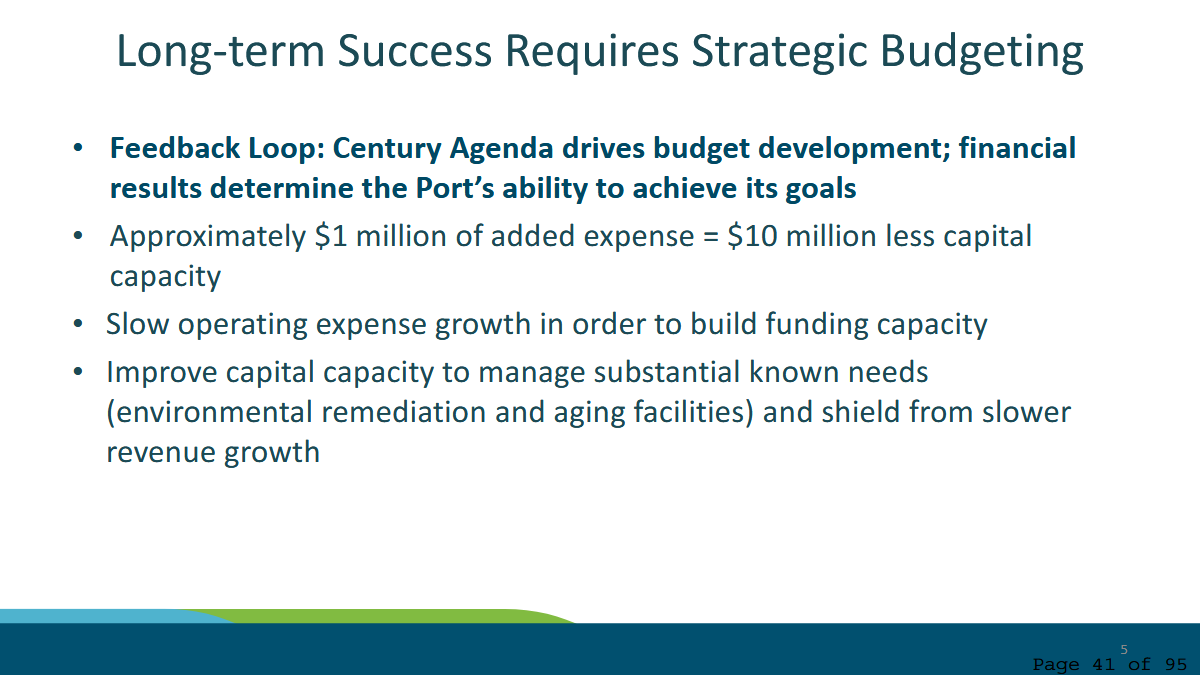 One detail of note we tried to emphasize in our last Podcast Episode
The Port is a borrowing machine. A majority of their budget and their effort goes towards capital projects – building things and borrowing to build even more. The first slides make their priorities clear. Every dollar they save on operations, yields ten dollars in capital projects. One dollar in cash can leverage ten dollars in borrowing capacity.
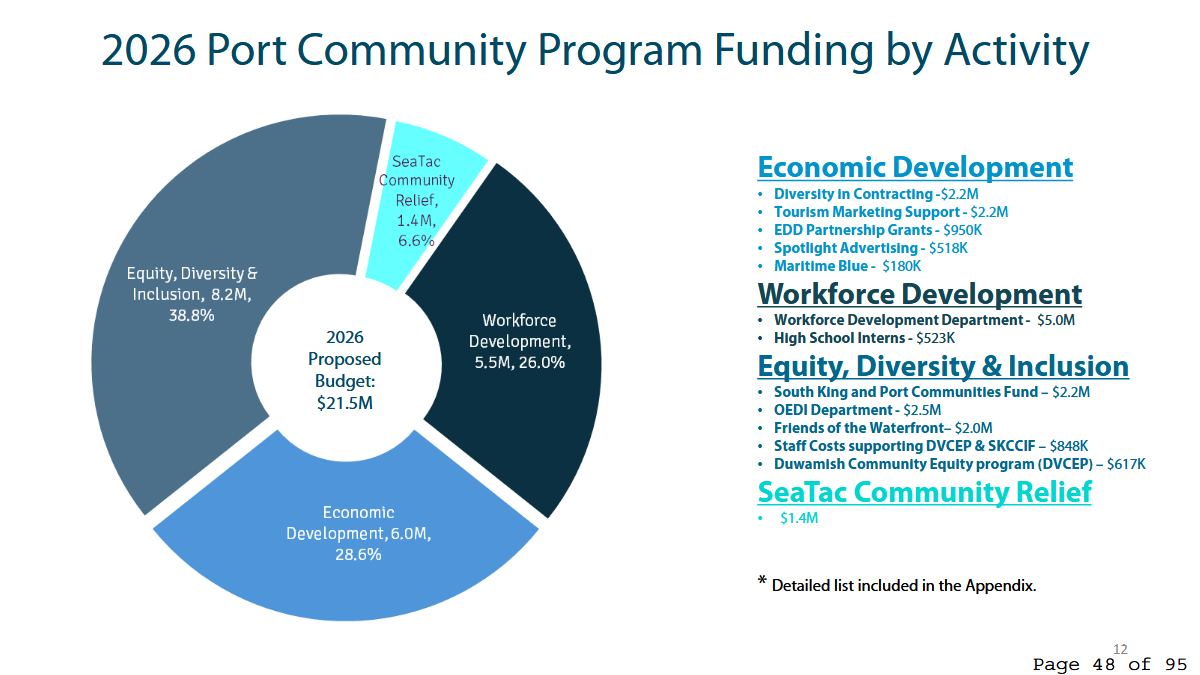 That is why they tend to be so stingy with us for tax levy dollars to address community benefit.
Unlike airport revenue, tax levy money is unconstrained. As the slide indicates, even small amounts of tax levy money can help pay down very large amounts on major spending projects. From their point of view, that is not only their mission, it is the most efficient use of that money
This is a core value they need to re-evaluate. Despite the fact that over 80% of their revenues come from the airport, and that a vast majority of the negative impacts stay near the airport, the Port always considers ‘the greater good’, meaning King County as a whole. So long as that is their yardstick, we will never achieve equitable treatment.
Our public comment today is to remind them that efficiency matters. Being so careful with tax levy spending is a choice. But making those few grant dollars so inefficient is unjust.