
Looks good. Just don’t read the fine print.
The Port of Seattle has released a proposed 2032 noise exposure map. We created our Port Package Map tool to help provide more context. The proposed 2032 boundary is overlaid on the existing 2018 boundary. The proposed boundary expands slightly in each direction, most notably to the north and south by about 1,900 acres – a 41% increase.
Small area, many homes
But for most people, noise exposure maps are not about acreage, they’re about who gets sound insulation. That 41% increase in acreage almost doubles the number of homes eligible for FAA first-time reimbursement.
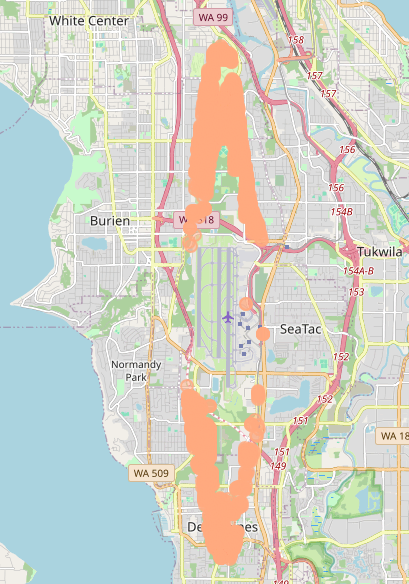 2454 eligible homes under 2018 NEM
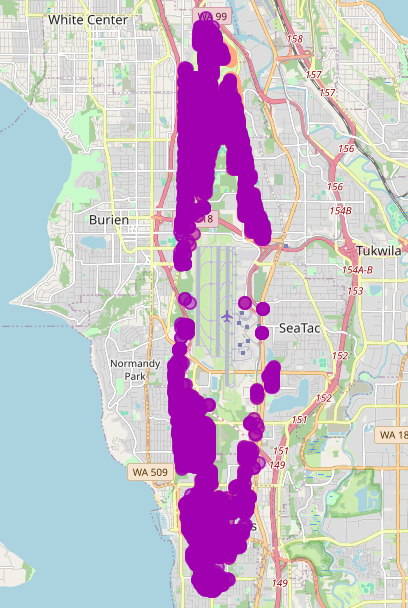 Estimated 2032 NEM may boost eligible homes to 4689 – a 91% increase.
On the other hand
- Reimbursement is currently available for first-time installs only – homes that have never received sound insulation. That number is closer to fifty three (53). Ouch.
- There is currently no federal money for updates to existing systems.
- Whatever the new boundary will be, it takes effect in 2032, not 2025. So, first time or second chance, the new map provides no federal relief for many years.
- Almost every existing Port Package was installed 3decades ago. Any home that cannot wait to replace doors, windows and other sound/HVAC treatments is permanently removing itself from any future federal program. We cannot stress that enough. If you do your own work before any new federal authorization, you will never be eligible for any federally funded second chance. Ever.
The Port’s solution is no solution
This is why we have struggled to support either the Port of Seattle’s SIRRPP and the SITRRPP federal legislation proposed by Adam Smith and Patty Murray. Both programs sound great – until you read 1the fine print and see so many loopholes they could end up helping almost no one.
Adding insult to injury the Port of Seattle has prepared federal and state legislative agendas and will ask StART members to lobby in both DC and Olympia next year on their behalf!
What went wrong
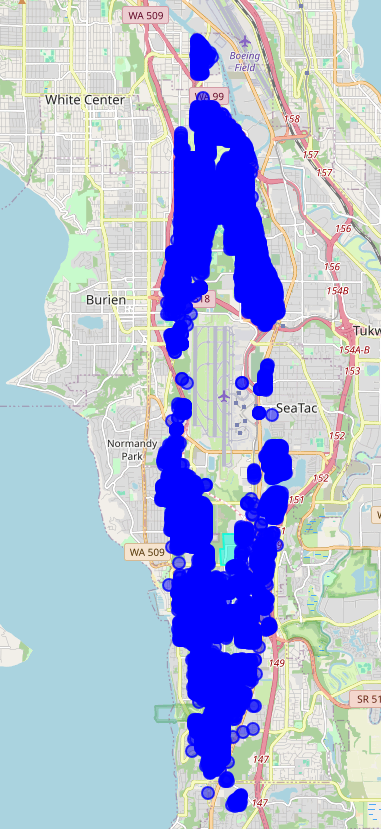 When the first Part 150 Study was done in 1985, the results identified almost 11,000 structures that might be eligible for sound insulation White Center south to Federal Way.
About 9,400 structures were completed. But large scale problems with product and workmanship were identified as early as 1998, not ‘normal wear and tear’. And many multi-family structures were still uncompleted as of 2020 requiring an Accelerated Sound Insulation program three decades later.
The Port of Seattle never installed Port Packages voluntarily. They were required by the Puget Sound Regional Council to do so before they were authorized to build the Third Runway. Until recently, ‘voluntary’ has not been on the menu. Perhaps that is why they stumbled with their first attempt at a Port Package update program.
Through attrition and a DNL65 boundary which kept shrinking until this last study (because ‘the airplanes are getting quieter!’), only a fraction of those original installations would ever be likely to be considered under the Port’s proposals. Ever.
The real solution is simple
There is nothing preventing the Port of Seattle from funding its own sound insulation program. It can include whatever area it chooses! Again, the entire Part 150 program is voluntary. Noise exposure maps only determine federal reimbursement – which you can see has almost no meaning for the majority of people living under the flight path.
There is nothing preventing the Port from adopting an improved version of the San Francisco International Airport Second Chance Initiative. The Port has been aware of this since 2018. We cannot understand why it proposed the SIRRPP, when there was already a simple, working program at another major airport.
Make every home within the initial boundary eligible based on an equitable first-come, first serve lottery system. Will there be as much initial money as the federal government could provide? No. But which would you rather support, a real second chance for everyone who deserves it, or a much wealthier benefactor that hasn’t delivered in decades? The Port does not have as much money as Uncle Sam. But it is doing better than any government in the State of Washington. And it can afford to reliably fund its own program.
Every home under the flight path is at least as impacted now as it was in 1991. The airplanes have not gotten quieter. They are not providing fewer harms to public health. And with the SAMP, they will only get more numerous.
Call to action
In 2023, the State passed SB5955 establishing an account to administer sound insulation funding. The Port should simply commit to funding it annually and get to work fixing Port Packages now. Then ask StART members to lobby the federal government to add even more funds and, improve a working program.
Stop using the empty promises of any DNL65 map to distract and delay from getting to work now.
1The programs were clearly designed as a piece – right down to the acronyms – and with no community input on what good legislation would look like. Even though both the Port and Congressman Smith’s office have been aware of the SFO
2Neither the SIRRPP or the federal SITRRPP were designed with any community input on what good legislation would look like. Even though both the Port and Congressman Smith’s office have been aware of the SFO program since at least 2019.
3Ninety five percent of sound insulation systems were installed between 1998 and 2008.
I had my sound package installed in 2000. Milgard Quite line windows were installed. My home was the first one to use the new milgard product. Milgard has been good in fixing the failed double pane windows when they fog up. My problem is that all the double hung windows are sagging in the top frames. Now they don’t seal as the weather seal is exposed due to the sagging. When I contacted them about the problem they blamed the installer for not screwing the tops of the frames. That was contrary to being told by one of their technicians that they NEVER put screws in the top frame as it may cause leaks. Also during the time of install, due to it being a brand new product there were several representatives from both the Port of Seattle and Milgard onsite numerous times looking at the install and taking pictures. Not sure how the improper install happened. The holes for the screws were PREDRILLED in the SIDE FRAMES of the windows. Not the top. Anyone else have this problem?? Thanks JP