A lot of money. A master class in PR.
The Port of Seattle Commission’s May 13, 2025 meeting (Packet) included a 10-year contract extension for airport noise monitoring, a proposed $950 million bond issuance for aviation projects, and updates on environmental and equity goals – including sound insulation replacement/repair.
Noise Monitoring contract extended through 2035
The Commission approved for a 10-year, $4 million extension of the Port’s contract with Passur Aerospace, which manages SEA’s noise monitoring and flight tracking system. The system uses 24 strategically placed microphones to collect real-time data and align noise events with specific aircraft. When residents see noise readings on the Port web site or in various noise apps, that is the data source.
The system was originally created as part of the Port’s initial Part 150 Noise Compatibility Program. However, it has no bearing on the DNL65 boundary (who gets sound insulation or not) and the results it provides have no regulatory force. Noise complaints are logged, but their only application is the voluntary Fly Quiet program the Port runs to encourage airlines to avoid exceedances.
$950 million in new bonds
The Port Commission authorized up to $950 million in revenue and refunding bonds. Approximately $700 million will finance major capital improvements at SEA. Key projects include the S Concourse Evolution, C Concourse Expansion, the SEA Gateway Project, and additional airfield and utility upgrades. This large-scale borrowing reflects the Port’s need for $3.4 billion in new bonds through 2029.
The Commission is always careful to mention when projects are not a formal part of the SAMP. Don’t believe it. As we say over and over: the airport is a factory. If it makes for faster passenger processing, it increases capacity. If it increases capacity, it is the SAMP.
The Port’s ability to borrow is an indicator of their ongoing financial strength. In both the Third and Second Runway expansions the Port’s finances were stretched almost to the breaking point due to cost overruns and poor management. Even with the recent IAF debacle, the Port’s financials look very good.
Equity and Environmental Sustainability Presentations
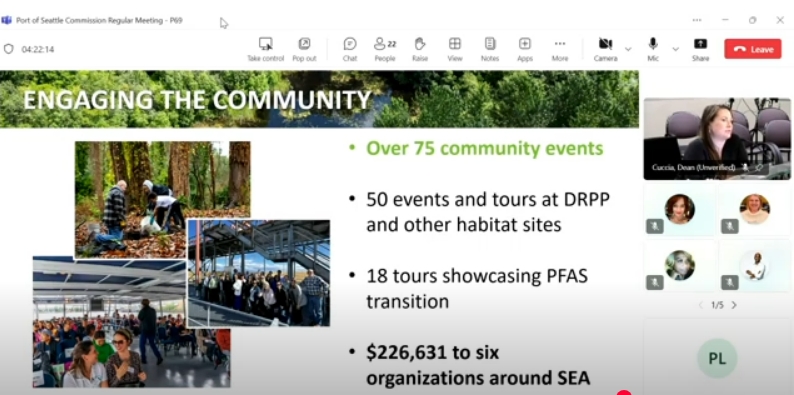
- Item 11b: The Port’s 2024 Environment and Sustainability Report, detailing progress in clean energy, sound insulation pilots, and habitat projects, including the awarding of over $226,000 to local organizations through the South King County Community Impact Fund
- Item 11c: The Office of Equity, Diversity, and Inclusion’s 2024 Annual Report, which outlines initiatives focused on workforce equity, community partnerships, and environmental justice in airport.
These presentations were perhaps an even more powerful example of how much better the Port is now doing than in previous decades.
The Port doles out a great number of small community grants every year. The benefits are real. But that money all comes from your property taxes, not their revenues. So the Port gets to provide dozens and dozens of legit photo-ops at essentially zero cost.
A detail mentioned by Commission Felleman is that the Port has established its own Mitigation Bank – meaning that the Port now gets paid by other agencies to maintain the Port’s environmental mitigation sites — such as the Auburn Wetlands meant as a ‘mitigation’ for the Third Runway. How a wetland reclamation located in Auburn helps Sea-Tac Airport Communities is one question. How the Port can get paid to take care of it is another — one of hundreds of completely legal, but totally unjust legal maneuvers the Port is able to get away – instead of committing to provide relief to the people under the flight path.
Commissioner Mohamed asked about the SIRRPP program (Port Package Updates), applauding the fact that the Port is now working with sixty applicants. That sounds wonderful until one pulls back the lens:
- Over 9,400 homes originally received sound insulation, and many thousands are in need of repair.
- The program was unveiled in February of 2024
- The next check-in will be after a second testing phase in September
Which means that after two years and $6.5 million budgeted, likely zero homes be fixed. Also, the three homes and religious buildings worked on last year were actually first time installs – left over from the Third Runway Mitigation program of 1996.
Greenwashing
Commissioner Felleman noted the excellence of those presentations. We agree. He constantly asks the staff to do more. And from a cynical point of view, we understand. The net effect of all these great presentations is a public relations blitz on a scale airport communities cannot possibly hope to match. The more greenwashing the Port does, the less opposition it receives.
Almost no one points out anymore that the negative impacts of both the airport and maritime industries swamp any of those small grants (which we pay for). All the fancy presentations blind decision makers as to how little the Port actually does to mitigate the harms for people under the flight path.
For decades the Port was seen as a badly managed organization with almost constant corruption and poor PR. Despite their power, this poor image made it somewhat easier for the public to push back. Since then it has learned. Financially, it is somewhat better managed. But more importantly, it’s public relations is much better managed. And that is the real challenge for airport communities: telling our story in a more effective way.