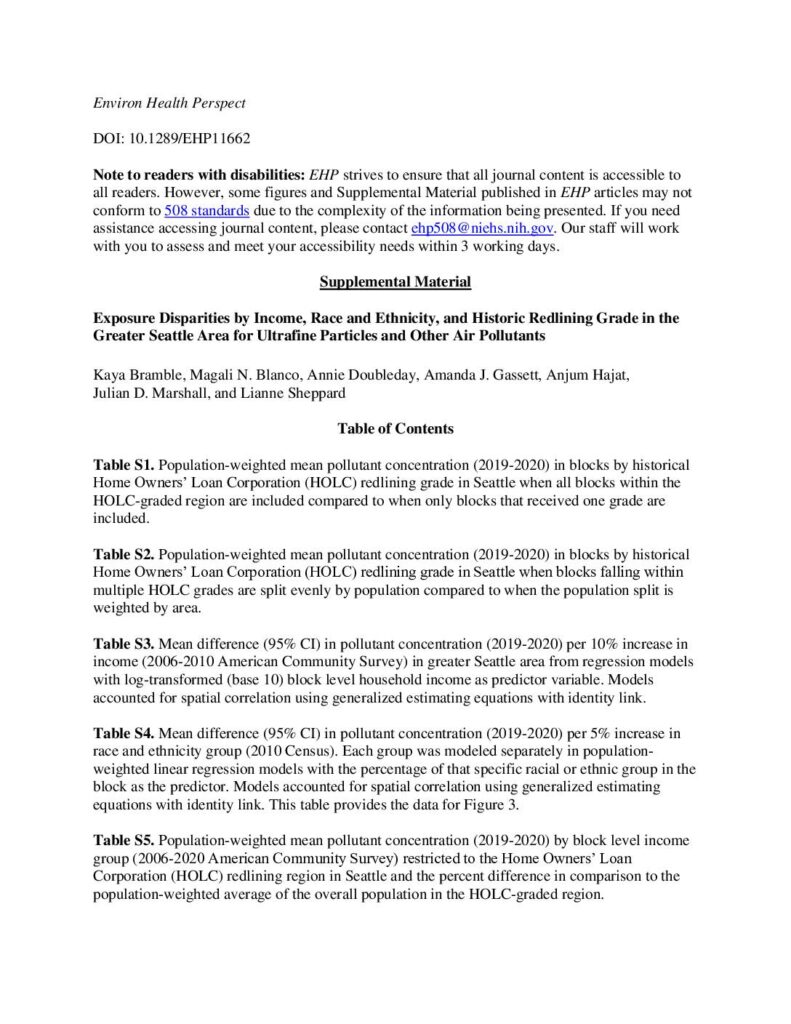
This environmental health study examines how exposure to ultrafine particles and other air pollutants varies across the greater Seattle area based on income, race and ethnicity, and historical redlining grades assigned by the Home Owners' Loan Corporation (HOLC). Researchers analyzed pollutant concentration data from 2019-2020 alongside census and demographic data to identify disparities between communities. The supplemental materials include statistical tables and scatterplots supporting the main findings on environmental inequality across Seattle neighborhoods.Open full document
Notes
Supplemental material for a study published in Environmental Health Perspectives examining air pollution exposure disparities in the greater Seattle area. The document provides tables and figures analyzing pollutant concentrations (2019-2020) by income, race and ethnicity, and historical HOLC redlining grades. Methods include population-weighted regression models using generalized estimating equations to assess relationships between demographic factors and ultrafine particle and other air pollutant exposures.