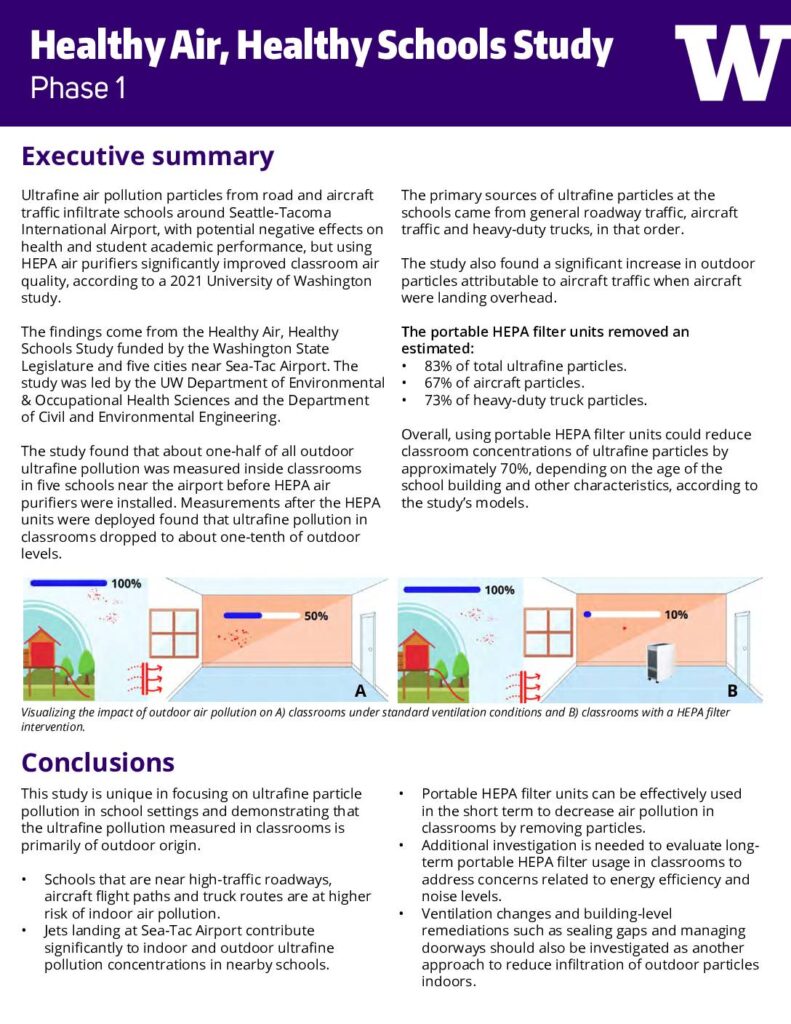
A 2021 University of Washington study found that ultrafine air pollution particles from road and aircraft traffic near Seattle-Tacoma International Airport were infiltrating nearby school classrooms, with indoor levels reaching roughly half of outdoor concentrations before any intervention. Installing portable HEPA air purifiers reduced classroom ultrafine particle levels to about one-tenth of outdoor levels, cutting overall particle concentrations by an estimated 70%. A follow-up Phase 2 study is now underway in 30 Washington schools to examine longer-term air quality improvements and their effects on student health and academic performance.Open full document
Notes
A 2021 University of Washington study found that ultrafine air pollution particles from road and aircraft traffic infiltrate schools near Seattle-Tacoma International Airport, with HEPA air purifiers reducing classroom ultrafine particle concentrations by approximately 70-83%. The study identified general roadway traffic, aircraft traffic, and heavy-duty trucks as the primary sources of ultrafine particles. Phase 2 of the study expanded to 30 schools in urban and rural Washington settings to examine longer-term air quality, health, and academic performance impacts.