Theme: 2024 StART Annual Report and Economic Development Grants
Highline Forum Agenda May 28, 2025
Burien City Hall, 2:30pm
Host Update: City of Burien
Mayor Kevin Schilling (Burien): We’ve been very focused over the last years on our comprehensive plan – how we distribute resources, where we are building out capacity for transit, for transportation, for open space, for redevelopment, economic growth. It’s been a robust and exciting time in the city as we are trying to balance the needs to grow and maintain community harmony and balance around some issues.
Specifically over the last few years, I have been very excited about what we’ve been doing with our comprehensive plan and our economic development plan. We have been successful in doing an immense amount of community outreach to expand our density opportunities, to bring more development and growth into the city because I think one of the things that our community knows full well, and I think some of our neighbors is that we have a lot of opportunities for redevelopment and density and growth.
We have a lot of underutilized land, a lot of underdeveloped land. What’s great about this group here is that it’s an opportunity to share and coordinate understanding how we plan for growth ourselves, how we plan for growth in relationship specifically to the Port of Seattle and the airport’s footprint, and also finding ways to be mutually beneficial in reaping the benefits of economic development and economic growth.
So we’ve been focused on that when we think about our planning over the next few years for transportation, housing, and growing our economy. Speaking of growing our economy, as the city of SeaTac knows, as Des Moines knows, as Tukwila knows, we are all immediately situated in proximity to a large entity that has opportunities to support growth and support investments, whether it’s in arts and tourism, whether it’s in small business development, workforce growth.
Burien is proud to be a place that for decades now has had a large majority of its population work in aerospace, aviation, and fields that are proximal to those industries. I am the son of a 35-year Boeing employee. I am the grandson of a 35-year machinist. It’s pretty much in the blood of folks who live around here.
I think that our economic development action plan for our community was certainly focused on ways we can bring about more industry here that both positively grows Burien’s economy while being in partnership with our surrounding communities and the port to make sure that those investments are positive and long-term.
Obviously, our commercial redevelopment is really important to us. I think that our partnerships with the Highline School District can be working even more so to find pathways to get kids – I went to Aviation High School, and it has ingrained in me to say prepared for college, career, and citizenship. And I think that we are in a prime spot for not just Highline students, but students in this region to be prepared for college, career, citizenship, and that’s all workforce.
Arts and tourism are places that we’re eager to find ways to invest more in, specifically around hotels and bed and breakfasts, preparing for the World Cup. As everybody is preparing for the World Cup and thinking about ways to be more ready for that and to integrate ourselves more in getting benefits from that global event.
One way to do that, and one important way to do that is by continuing our own personal investments as a city and as a community, whether that’s in workforce opportunities with the school district or workforce opportunities through investments we’ve made directly with trade programs, apprenticeship programs, non-traditional employment opportunities for women, as well as formerly incarcerated individuals, and partnering with our local Chamber of Commerce.
Opportunities for our high school students before they either go into workforce programs, higher education, whatever pathway they take – and I went to community college, I went to South Seattle Community College, and I’ve had my fair share of additional classes at Highline. There you go, Josh, a little throw in there.
But to make it even more personal, when I was born, my mom was working at a business that was aerospace related, and when we were little kids, me and my sister, my twin sister, she took advantage of – back in the ’80s – but she took advantage of Highline College’s community college evening programs when she got her AA. And the only reason why she was able to do that was because Highline had a childcare facility that should be named the Kevin Schilling Childcare Center for the amount of time that I spent in that room.
But we’ve invested – the city itself has invested hundreds of thousands of dollars into childcare opportunities. So this year, we’re going to have 10 childcare centers start up by the end of the year, I believe, is what we’ve heard that folks are on track for that timeline, if not directly by the end of the year, soon after. But we’re really excited about the investments we’ve made and grown childcare opportunities.
We’re exploring a new airport shuttle program, which I think is well overdue. I mean, Burien as a community should have started that when we first became a city. It’s a well overdue investment and opportunity for us to have something like that happen, and we’ve been focused, of course. We’re always focused on supporting our unique small business community and providing resources to – oh God, that’s Mad Men, sorry. I’m like, now I’m distracted by thinking about Mad Men. It’s only my favorite show of all time. I feel like I’m Don Draper right now, actually, in a pitch to everybody.
Our storefront support system that we’ve invested lots of money in because our small business community here in Burien, we believe, is pretty unique but is also necessary for thriving and robust economic climate.
The other thing that’s necessary for a thriving and robust economic climate is a transit system that actually gets people where they’re going. We’ve been really proud as a city to continuously push for and be in favor of expanded transit opportunities between Burien and Seattle, the port, our neighboring communities. We had RapidRide H Line come in. That was a multi-million dollar investment, about $11 million a couple of years ago, and it’s finalized.
We’re always dealing with our own community concerns around investments we’ve made, and one of those concerns is, of course, that folks think that we need to be doing a better job of Metro to let people drive in bus lanes at certain times. One of those micro community city issues that we’re having constant conversations about. But that was a huge investment, and I’m really happy to see the RapidRide taking off here in the community and going up through downtown Seattle.
As everybody here knows, we have the 509 Extension project that’s going in, and the city council here spent a lot of time communicating with the extended community about these investments that are going in. I’ll be frank, and I’ll be honest, I am still remaining somewhat concerned about this project, and we’ll see if my concerns are founded or not. I hope they’re not. I hope that the project will be positive, and that we won’t see traffic jams in Burien with semi trucks and lines for gas stations and things like that. But certainly the investments are looking positive and I’m happy to see that.
So transit is a vital part of Burien and its connection to the rest of the community. And hopefully, we’ll see more direct partnerships to expand transit options to get people to the airport, to and from the airport, to and from the light rail.
I think this council and this city has done a significant amount in relationship to public safety and growth. I mean, obviously, Burien’s been in the news over the last year and a half for our public safety efforts and getting folks successfully off the street and into shelter and services, while creating a safe community for everyone to access and be available to walk through the streets and go shopping without fear of something happening or having the sidewalks blocked or whatever.
We’ve been in the news for our efforts to expand services on one end, but also enforce the law on the other, and one of the reasons why we’ve been able to do that is because of our successful co-respondent model that we’ve put a ton of money into – getting police partnered with mental health professionals so that when they do encounter someone struggling with mental health issues, they’re able to connect those people directly to services right away. And we’ve been able to do that because we put a lot of money into our service provider and housing and homelessness prevention money, housing and homelessness supportive money.
We have lobbied and advocated and gotten millions of dollars to expand Mary’s Place, support more affordable housing projects, so these things go hand in hand – enforcing the law and investing in social services goes hand in hand. You can’t do one or the other. You have to do both in order for communities to be successful at getting people connected to the services they need to get connected to while also maintaining a safe and thriving place for everybody.
So we were proud that we put in $2.9 million from our ARPA money into those investments. We are going to be continuing to figure out how to ensure that those stay at those levels. But certainly we’re going to still partner with our neighbors and with the county to make sure that we’re getting what we need to fill empty police spots right now. We have some empty ones.
We’re pushing the county to fill those because, as we all know, here in South King County, we’re an under-resourced region. So we need everything we can get, and we’ve been working on that as much as we possibly can.
One way we’ve been doing that through our inclusivity work around folks who come here from different parts of the world. Like I said before, we are proud to be a very diverse community, and we are extremely helpful in helping immigrants start businesses, get housed in the city, and connect around the community with other businesses and non-profits and organizations to help their families thrive, because that’s why they came here, and we’re proud to be an extremely diverse community, and that reflects its diversity actually on city council.
We have folks that identify as Hispanic. We have men, we have women, we have LGBTQ individuals. We have leadership in the city that reflects the diversity of our community, and we’ve been very focused and ensuring that we are doing that because it’s important for folks in the city to see their leadership reflect how the community looks and how it exists.
And one way we’ve been doing that is by making our community a creative district. We’re very proud of that. We’ve been working hard with our commissions to keep investments coming to help grow and support arts and culture, food accessibility, small to medium-sized businesses. This all makes Burien unique in its offerings, and why people choose to live and work here.
We’ve been – I’ve been very proud of that as someone who was born and raised here, and is the exact same age as the city itself. And I think that as we move forward and as we continue to think about the relationship between not just my city and our cities and the Port of Seattle, we need to – this is my thoughts on all of our collective working together to ensure that the investments and the growth we can make as partners is widespread so that it’s not just one entity or one government seeing the benefits, investments, and government direction, but we’re spreading it out and that we’re also working together to ensure that if there is any kind of negative externality associated with activity, the activity in whatever capacity, we’re working hard to ensure that we immediately respond to that.
So that there is negative health impacts, negative environmental impacts, or that our communities are saying, we support one another when to invest and grow, and we’re smart about it. We’re thoughtful about it. We’re strategic about it, and we remember that there is a limited amount of space both for cities and the port.
But I want to make sure as we move forward over the next 32 years, when we see the communities in 2057, that in 2057, this area looks like an area that is partnering to continue to grow and innovate and be a place that’s expanding opportunity for all. And I think that means having each other’s backs and listening and not moving aggressively one way or the other, having a balanced approach.
So thanks for being here in Burien for the forum today. And I’m happy to take any questions if you have any questions about Burien or anything.
Joe Vinson: My heart – you mentioned that you’re working with King County to fill those vacancies with your police force. Can you share a little more of that?
Mayor Schilling: We have been down over the last few years. It oscillates back and forth, but around 12 officers in our police department through our contract with the sheriff’s office. We have asked repeatedly – it’s a constant request – for the sheriff’s office to fill those vacancies. And we certainly need them because, as you know, being our neighbor, we’re a pretty high crime area, and we need all the help we can get to prevent crime, to address crime. And we’ve continuously asked for those positions to be filled.
Adolfo, would you have anything to add to that, besides just that we’ve continuously pushed to have them filled?
Adolfo: Yes. Also, I could add exactly what the mayor mentioned, but also that we’re working with the sheriff’s office to bring in-house county assets. So the city’s taking on additional workload by – every city is at roughly about 85% staffed, but we also brought in resources to help the county with its financial problem of our co-response team. They now perform work outside of Burien. Some of our two of our deputies also perform work outside of the area, and so we’re helping the county with its financial crunch, but also understanding that there’s equity that needs to be taken into consideration where the high crime areas are. Those are the cities that should be staffed sooner versus areas with less crime.
So I think we’re able, as we continue to partner with King County, we take on the brunt of the load when we can. We also allow them to see that we’re working with them, and hopefully they could continue to staff us more than other places.
Tukwila Councilmember Armen Papyan (Moderator): Are there any other questions or comments? I see none. Thank you so much, Kevin Schilling, Mayor Schilling for your presentation and for your work, your council members’ work and the staff at city of Burien for taking on a lot of these big issues and topics from coordinated growth to economic development to public safety.
And we’ll move forward before we move on to our next agenda. I just do want to mention that Commissioner Cho is with us now. He did join us. Well, we’ll move forward to our next agenda item, which is StART annual report.
StART Annual Report
Moderator: So back in 2018, Aviation Managing Director Lance Lyttle and a few of our city managers expressed interest in the idea of creating a venue for representatives from the community to gather to help address impact of current aviation operations on the surrounding communities.
Since that time, the Sea-Tac stakeholder advisory roundtable, commonly known as StART, has been meeting and working to identify ways to help mitigate aviation noise impact, to advocate for specific federal policy changes in Washington, DC, with Congress and Federal Aviation Administration. For the first time this year at the Washington State Legislature in Olympia.
Today, we’re going to hear about the progress that has been made by StART in 2024, followed up by a recap of 2025 state legislative session on StART priorities. With interim Aviation Managing Director Eric Carlson on work-related travel, we have StART facilitators from Uncommon Bridges, Andres Mantillas, Aviation Community Engagement Manager, Marco Milanese, Senior Federal Government Manager, Eric Schinfeld. Abby filling in on behalf of Eric. Andres, please get us started.
Andres Mantillas (Uncommon Bridges): Great! Well, thank you so much. I’m just confirming, you can see me and hear me okay? Okay, right. Well, good to see you all again. Thank you for inviting us into this space to provide an update on the Sea-Tac stakeholder advisory roundtable StART’s progress in 2024 and 2025.
As mentioned, my name is Andres Mantillas. I am a partner in a company called Uncommon Bridges, and we are tasked with facilitation of this group. StART’s chair Arif Ghouse and StART’s alternate chair Sarah Cox were not available for today’s presentation, and so he asked me to step in.
I want to begin today’s presentation with a quick overview of StART, including its purpose and its structure. Several of you in the room participate in StART, and this is a bit of a review for you. All others aren’t as involved, and then Marco and Eric, who I’m joined by today, will cover the more specific programs and initiatives that StART’s Aviation Noise Working Group and the Policy Working Group have focused on in 2024, and for the first half of 2025. And then we’ll be able to answer your questions at the end of the presentation.
So the purpose of StART is recognizing that Sea-Tac Airport’s operations and location – it operates within a dense residential and commercial area in Puget Sound – the Port of Seattle with its commitment to build relationships with the community and local cities to foster trust, accountability, and collaboration, and a component of that was the creation of StART in early 2018, under Lance Lyttle’s leadership.
In close coordination with the city leaders from your six Highline Forum member cities, the Port of Seattle and its partners developed StART to share information, collaborate, and achieve results. StART also offers a dedicated forum for discussing and addressing airport-related issues that are most pertinent to Highline Forum member cities and their residents.
Each city designates three members to serve on StART – two community representatives and one city representative. These members are accompanied by representatives from Alaska Airlines, Delta Airlines and Air Cargo operators, and then Port staff. Federal Aviation Administration participates in an ex-officio role and provides agency expertise.
With Lance’s departure earlier this year, Eric – the airport’s interim managing director – will take on the role of StART’s new chair. Meetings are typically held every other month and are facilitated by myself with assistance from my colleague Cheryl Schwab, again from Uncommon Bridges.
StART’s steering committee offers support, guidance, and institutional direction for StART. Made up of the port, the six cities, and two airlines are all represented on the steering committee. The steering committee decides the size and extent of StART’s membership, areas of focus for StART, what to include on StART meeting agendas, changes to how StART operates as an advisory roundtable, and importantly, it operates on a consensus-based guidance, which means that consensus base shapes all the decisions made by StART’s steering committee and its two working groups and StART itself.
Don’t provide to StART with staff support, technical analysis, and expertise, but every member is bound by the StART’s consensus-based approach and cannot take any unilateral action to shape agendas or areas of focus or how StART operates, including membership positions. Those have to be consensus-based decisions.
StART established two working groups to empower its members to address the identified priorities between meetings: the Aviation Noise Working Group and the Policy Working Group, formerly known as the Federal Policy Working Group. StART’s significant achievements are largely due to the efforts started in the two working groups, and so we’ll turn it over to Marco to take us to the next slide and the more details of the aviation noise working group.
Marco Milanese (Port of Seattle): Thank you, Andres. I’m Marco Milanese, Aviation Community Engagement Manager here at Sea-Tac, and thanks for the opportunity today to address the Highline Forum. For those who watched the commission meeting yesterday, sorry for the repeat today.
Since its creation, StART’s Aviation Noise Working Group has focused on prioritizing and exploring potential near-term actions to reduce and prevent aviation noise. In 2024 and 2025, continued its work on what it refers to as the near-term noise action agenda, which includes several programs and efforts we’ll get into in a minute intended to provide aviation-based relief to the Highline Forum member cities, but with more of a focus on 2024 and 2025 on results monitoring, program refinements and promoting the agenda’s outcomes both to internal and external audiences.
Before I dive into 2024-25, let me quickly recap the working group’s previous accomplishments starting with first, late night noise limitation program, which was launched in 2019. The program is a voluntary effort to reduce late night noise by incentivizing air carriers to fly at less noise sensitive hours, or transition to quieter aircraft. And the program includes regular reporting each quarter to StART and its member carriers and other external audiences on all airline noise events above established noise thresholds for the late night hours. Those late night hours are from 12 to 5 AM.
UPS and FedEx Express are two carriers the Port has met with as part of program’s outreach, and both carriers did eventually incorporate newer, quieter aircraft into their fleets. Aircraft fleets go through frequent changes, which is no surprise, and so Port staff continue to meet with air carriers regularly about late night noise.
In 2020, Port leading meetings were held with China Airlines Cargo – continued transition to the quieter 777 – and with EVA Air to urge for greater use of their 787. And this came up at yesterday’s commission meeting, but we did get some recent good news. China Airlines Cargo, which does a lot of the shipping of cherries overseas to Asian markets, they have committed for the upcoming cherry season to use the 777, which is a big noise improvement over the 747, and so we at StART will try to find a creative way to thank and congratulate them for that.
The informal runway use plan minimizes use of the third runway during the late night hours, and again from 12-5 AM. And the late night operations have dropped dramatically on the third runway since implementation back in late 2019. Prior to the runway use plan, the third runway was averaging about 12 to 13 operations during the late night hours, and in 2023, the average was less than two operations per late night.
In 2024, the average did bump up a bit, and that was primarily because of nighttime runway construction on the other runways that pushed more traffic to the third runway. However, through May of this year, the average number of late night operations on the third runway has been 2.8, which is back in line with where it was before.
Today, accessible and detailed information on all noise complaints and comments submitted by the public online – monthly reporting began in June of 2020, and reports are provided out at all working group meetings and on the port’s website.
Reverse thrust is used by pilots to decelerate aircraft upon landing, and it is also an identified source of ground noise at Sea-Tac, and probably communities to the west of the third runway are pretty familiar with this noise. In coordination with the FAA with the carriers and the members of the working group, updated voluntary airport language, discouraging the use of reverse thrust beyond what is necessary, was implemented in early 2023.
Continuous taxi and takeoffs, whereas it’s more commonly known as rolling takeoffs, have less of a noise footprint than traditional takeoffs that require an aircraft to power up after a complete stop at the end of the runway. Continuous taxi and takeoff was enacted in mid 2023.
Looking at 2024 and 2025, the working group continues to finalize new voluntary language to provide aviation-based relief to those Highline Forum member cities. One of those is single engine taxiing, which is an existing practice with many carriers here at Sea-Tac. Both as a modest effect on noise – reducing noise – it does have a measurable effect on reducing aircraft emissions. So again, in coordination with the FAA, the air carriers, and the members of the working group, voluntary Sea-Tac language promoting its use was enacted in the fall of 2022.
Directed by the Port Commission for staff to develop and implement a comprehensive analysis of single-family homes that have previously received a Port-funded noise insulation package. The working group was briefed throughout the assessment with multiple opportunities to ask questions, provide input, and in early 2025, the Port’s reinstallation pilot program was announced. The working group was the first external audience to receive a preview of that program.
Finally, in 2024, the working group began participating on the Sea-Tac Part 150 noise study’s technical review committee. A Part 150 noise study is required by the FAA to update airport noise programs and establish eligibility for FAA grant funds. The airport typically stands up that technical review committee, also known as the TRC, during the study and tasks it with providing technical input and guidance throughout the life of the study.
Working group members participated on the TRC in two of the 2024 Aviation Noise Working Group meetings included substantial agenda time dedicated to that Part 150 noise study. The technical review committee offers working group members a really significant opportunity to influence current aviation noise reduction and prevention programs and recommend new approaches where appropriate.
The working group’s next meeting in June – early June – will primarily be focused on the Part 150 noise study, and we expect to see a heavier focus on the study at all upcoming Aviation Noise Working Group meetings in 2025 and into 2026, as that study picks up speed. And now I’m going to turn things over to my colleague Eric Schinfeld.
Eric Schinfeld (Port of Seattle): Thanks Marco and good afternoon, everyone. Happy to be here with you again. My name is Eric Schinfeld. My day job is Federal Government Relations Manager for the Port of Seattle, and I’m one of the staff at the Port of Seattle that staff the Policy Working Group.
So Marco told you a little bit about the Aviation Noise Working Group and some of its real focus on very tangible, practical near-term actions that can make an impact in the community. At least initially, the Policy Working Group was focused on the federal level, trying to actually change federal laws that allow for more resources, more tools, more flexibility to address some of the community concerns that we hear around aircraft noise and emissions.
And so what we did is we created a Port and cities federal agenda and advocated on that agenda and saw so much benefit in that that last year, we then used it to create a state policy agenda, a Port and city state policy agenda, and actually changed the name of the working group from what used to be the Federal Policy Working Group to the Policy Working Group, including both federal and state policy.
StART has actually created joint state and federal policy agendas with its surrounding cities to try and move the needle and make progress. And I will say, you know, in all honesty, policy things take time, as I think all of you know very well, but I am really pleased that we’ve been able to show at least incremental progress right now and create opportunities in the future.
So many, you know, the story I like to tell is that when this policy working group started, a lot of times, the Port would say sorry, there’s not something we can do about that, that’s federal law. Really one of the main goals of this was to not say sorry, there’s nothing we can do about it because it’s federal law, but instead say, oh, that’s federal law, let’s go change that.
So 2024 was a pretty significant moment specifically because it was the passage and signing into law in 2024 of the FAA reauthorization bill. The FAA has to go through a legislative reauthorization every five years or so, and we were really perfectly positioned to take advantage of that. In 2023, we led about 24 Port and city representatives to DC for a multi-day advocacy effort to advocate for our shared federal policy agenda.
And then when the bill was signed into law in May of last year, four of our seven policies were in the bill. And I think that that is really significant. These are not by any stretch of the imagination the most world-changing policies, but I think it really demonstrates the power of coming together with a shared message and going to our elected officials in DC and identifying priorities. It allows them to focus more on those priorities and help us carry them over the finish line.
And I’ll just say that I think the most significant policy that we got passed is a requirement that the FAA look at whether or not the Part 150 process should be changed, should be added to, should be altered in some way. And so we were really worried about it being sort of an ongoing process with no end and no specific deadlines or deliverables. And so we actually passed into law as part of the FAA authorization bill a specific deadline for action, but almost as importantly, a stakeholder committee that’s going to advise the FAA on this process, including representatives from airport communities, from airports and from a lot of other stakeholders. So we’re really excited about that.
There were seven priorities on the federal priority list. We did get four in, but we’re not giving up on the other ones. And so in 2025, a lot of our efforts at the federal level are continuing to make progress on those other items that were not in the FAA authorization bill, and I’ll call out in particular, we have not given up in any way whatsoever on the idea that there should be federal funding – FAA funding – available for the repair and replacement of noise insulation.
Right now, using its own dollars to do this work, it’s really going to be the FAA and help us achieve that goal. And so we’re working really hard with Senator Murray and Representative Smith to get this piece of legislation over the line that would allow us to use existing FAA funding that we get for additional noise insulation to also be used for repair and replacement of the existing insulation.
About the DC trip – I do think our 2023 DC trip was incredibly successful. It was great to be there. It was great to stand shoulder to shoulder and actually have an impact. Obviously, there’s a lot of things changing at the federal level right now, and we’re really trying to understand sort of where the direction is. Certainly, control of Washington DC has changed since 2023 when we were there last time, but there is an opportunity again to show up again at the right time and continue to advocate for our shared priorities at the federal level. Maybe that’s this fall. Maybe that’s next spring. We’re still looking to have that conversation. We have a meeting next week as the policy working group where we’ll have this conversation about timing, and hopefully have some of you join us for that trip. It was great the first time.
I’m now going to turn things over to my colleague John Flanagan, who will talk through the state policy priorities and the work we did in Olympia this session.
John Flanagan (Port of Seattle): [Audio issues initially] Testing, testing one, two, three. How nice. Perfect. I appreciate it. As Eric mentioned, first annual is what we’re saying around here. Looking forward to bringing folks back to Olympia to continue to work on some of these priorities during the 2026 session.
So looking here at our five state priorities in big buckets, I think I’ll start with the bad news. We were not successful implementing the noise insulation repair replacement program. I think I heard that Mary Seabrook is in the room, so her and Senator Dhingra deserve a huge shout out for this work and the work that we did last session to secure state funding to supplement what the Port is already doing from the perspective of repairing those noise packages.
We walked into the budgetary year with, I believe, a $12 billion hole in the budget, depending on who you ask – somewhere $10 to $12 billion. And so with the legislature wanting to make significant cuts across the board and the governor agreeing to most of those cuts, unfortunately, the million dollars that we had placed into an appropriated account was transferred back into the general fund.
The only silver lining in that – and this is from the conversation that we actually had with the Department of Commerce and the ongoing conversation we’ve had with the legislature – the intent has always been for that money to be spent on actual repairs rather than surveys or any kind of community engagement things like that. We believe that the resources the Port has put forward are already adequate to cover those things and that we should be able to come back to the state or hopefully, you know, fingers crossed per Eric’s remarks, the federal government to utilize additional resources to actually repair packages when it makes sense.
So although that million dollars went back in the general fund, we will continue to have this, I believe, on the agenda. It will continue to be the number one priority, and we look forward to making progress again, I think, next session.
The second bullet – progress on additional regional airport capacity – really is just the work of the Commercial Aviation Work Group. For folks that didn’t have a chance to tune in, they had their last meeting on May 22nd actually up at Paine Field. Most of what they focused on in that meeting, or at least a large portion of it, was Paine Field’s airport master plan and the work that they’re doing there. They are being more publicly transparent than they have been in the past without increasing commercial capacity at Paine Field, which obviously makes a lot of the work of the commission easier over time.
We are now asking the commission to focus on a couple of different things as they move forward, knowing that at least part of our capacity issue will be answered, or we have a definitive answer on. So just for folks that are in the room, and I know that we’ve talked about this pre-session, we’re going to ask them to take a look at well, another long book. I should say that capacity near military bases and whether or not they could use a study on regional airports that actually have a split facility between military and commercial.
We’re going to be asking them to explore a conversation about incentives. As a reminder, we had talked pre-session and leading into this agenda about finding ways to incentivize communities who are receiving essentially that new facility or having a facility majorly expanded. So whether it’s sort of a tax incentive, whether it’s some sort of priority for infrastructure, things like that, so we’re going to ask the commission to take a look at those things as well.
We were successful in getting them to include some of the language that was vetoed as part of the enacting legislation for the commission back into the budget proviso. So for example, they are not allowed to look at Sea-Tac. They are not allowed to look at Boeing Field. They have to look at green fields. They have to disqualify areas based on overburdened communities, environmental justice issues, things like that, which they didn’t necessarily have to do before.
That third bucket – air quality. I think we played a lot of really great defense this year. Just to highlight a couple things, UW will continue their air quality work in the capital budget. I think there was something like $50 to $60 million in the capital budget for indoor air quality in schools. Specifically, there was I think around $25 to $30 million for air quality in overburdened communities, and that’s not counting the air quality equipment funding that’s in the operating budget for South King County communities – that’s $6 million.
We were able to defend the PSRC air quality proviso that was included in the operating budget. That’s $1.3 million ongoing to help out, and I think that the folks that are in the room today, I’ll be really quick here. We were able to secure an additional $16 million for WSU at Paine Field ongoing R&D and the work that they’re doing to put in place a SAF accelerator.
We were able to get some language included in the budget that asks the state to go out and build a project list for future funding for SAF infrastructure and facilities. And then I’ll lump together the clean energy grant program, green jobs program, and the hard to decarbonize program. We secured, I will say, about $100 million that could be utilized for SAF. So a number of other things are eligible, but a lot of that money we see is going towards sustainable aviation fuel, potentially depending on what our project applications look like. Nonetheless, that or on the last bucket item there, I won’t say much just because there are so many things we could talk about, but I think that although we came into the session with lots of concerns from a fiscal perspective, we walked out with lots of great investments and things like EV charging infrastructure, clean trucking, continued investments in multimodal transportation.
We were able to defend the money that should go towards establishing the regional high-speed rail network. So lots of success stories there that I can talk about with folks offline if folks have questions.
Thank you for allowing us the opportunity to present today. I want to thank everybody who’s involved in StART who made what we just summarized possible, specifically the community and city members who I engage with regularly and represent their cities’ and fellow residents’ interests in StART and, you know, just as I’ve witnessed firsthand, they give a deep commitment to service and a genuine desire to tackle the issues that are facing our community. So I’m happy to answer any questions.
Moderator: Thank you all. Thank you Marco, Eric, John, and Andres for your presentations. There is strength in bringing the six airport cities and communities together to collaborate. The approach is taken will no doubt continue to evolve over time. And also thank you for the legislative update as well. So yeah, we’ll open it up to the group. Are there any questions or comments?
Claire Gallagher (Port of Seattle): If I could just make a short comment. Claire Gallagher from the Port of Seattle. I think you saw this referenced in the comments, but I just want to emphasize as a person who helped work to set up StART several years ago, many years ago now. The connection to The Highline Forum was primary, so it was intended to support the Highline Forum members to recognize the range of impacts and effects that the cities have, as opposed to a broader regional look at things.
And I guess I just want to put that in front of you, remind you of that connection. That’s partly why we do make sure to report out to StART on every forum meeting so that you, as forum members and as representatives of your city councils, you know, hear the information, can ask questions. And I, I just want to offer the support of our staff. As you’ve seen, and of course Adolfo is available to you as the facilitator if we can help support maybe a presentation as part of your council meetings, or I know that it happens in Burien at the airport committee, but I just want to make sure that if there’s something that we can support to help your residents gain a little bit broader information about the work that you’re doing, the trips that you’re taking to advocate, the agendas that you’re supporting, it just seems beneficial.
I know that Des Moines, I think, had a presentation. And just something where it keeps it visible to your community. So if the resources can be a helper, if that sounds of value to you, I just want to bring that forward and make sure to sustain that connection of the Highline Forum and your work and the work that your city managers and your community reps are doing in StART and start.
Type of presentations, it can be whatever works, you know whether it’s your city council agenda, or if you have a committee that – whatever is helpful, but it’s just trying to get that more information more broadly. Five minutes could be 15 minutes. We can send staff and make sure – we didn’t, I don’t think we had any involvement with the Des Moines presentation that Joe did, yeah, so the city just went forward. We figured out what worked, but I just want to emphasize that important linkage to maintain.
So clear aside, another example as well, too. I know Brian and Jeff in the room, too. I know that at the Burien airport committee, they make sure to provide regular StART updates at those meetings, too, so that connection is being maintained. So anybody else, we’re open and happy to help.
Moderator: Thank you for providing that opportunity to partner with you and possibly have a presentation in our cities. We will definitely consider that or prep you to make a presentation.
So we did have the StART annual report and the StART legislative priority update, which are two parts of our agenda, but they were combined into one. So we’re gonna move, yeah. Oh yeah, so King County Council member Quinn has joined us. County Council member Quinn, do you want to say anything?
King County Councilmember De’Sean Quinn: Yeah, sorry, I couldn’t be there in person today. I actually left a health fair forum. I would just say the information as a Highline Forum is definitely beneficial, and I think now more than any time, local regional governments need to partner, so I’m very happy to see the presentation. That’s all I want to say as I’m in traffic, but apologize and happy to be here and happy to see some familiar faces as well.
Moderator: Well, thanks for joining us even in traffic. Well, we’ll move on to our next agenda item, which is the Port economic development partnership grant program.
Port Economic Development Partnership Grant Program
 Highline Forum – ED City Partnership Program
Moderator: Since 2017, the Port of Seattle has partnered with many of its 38 cities outside of Seattle to provide grants to help further economic development in our region. Whether for business services, business attraction, small business support, planning efforts, or creating events, the Highline area cities have been consistent applicants and recipients of the grants being provided.
Here’s who provided an update on the 2025-26 round of funding with the Port’s Economic Development Manager, Annie Tran. Also attending in support, I’d like to introduce Port Senior Director of Economic Development. Would you like to say a few words?
Economic Development Grant Presentations
A Boungjaktha (Port of Seattle): Good afternoon, everyone, and nice work with attempting to say my very difficult to say last name. But yes, my name is A Boungjaktha, and I am the newest member of the Port, overseeing the wonderful work of the Economic Development Division team, and I’m super excited for Annie to be here to share with you about our program that we just launched. It’s not new, but it is newer for the new budget year. So very excited to let Annie tell you more about it and making sure that your cities are involved and we can support partners and think of really creative and engaging ways for us to elevate job generation, of course, investment into our region, so I’ll hand it off to Annie. Thanks so much for allowing us to be here.
Annie Tran (Port of Seattle): Excellent! Good afternoon, everyone! Hi, my name is Annie Tran and I’m with Port of Seattle as their Economic Development Manager. So just to get us started, I’ll be recapping on what happened last year for our Economic Development City Partnership Grant, and then I’ll go into a little bit about our two-year cycle that we just kicked off last month.
So a little background. As mentioned earlier, the city grant program first started in 2016, and it is a unique program that the Port offers in the way that it is a non-competitive city funding program. So we work very closely with the city partners across King County to help support local and regional economic development efforts.
In 2016, this program was started. The Port had seen that there were very few resources available in terms of funding local economic development projects, and actually, interestingly enough, this still remains to be the case today in this economic and political climate, and so we’re very excited to continue working with city partners. Thanks to our commission, who approved the funding for this program for the next few years.
And so a little bit about the program parameters. This program is based on a per capita funding formula. However, we did up the minimum for smaller cities. Last year, it increased from $5,000 to a minimum of $10,000. So for example, the city of Normandy Park, I believe, has about 6,000 residents, they are able to apply for a minimum of $10,000 to support their projects each year, so that if they can, they’re eligible to apply for $20,000 in this next round.
Another example is Federal Way. I know there’s quite a lot of folks that live there. I believe around 90-plus thousand folks in Federal Way are eligible to apply for $60,000 per year times that by two for our two-year cycle.
And so with that, cities must provide a 50% match to be able to be eligible for this funding, and 25% of that can come from in-kind resources like staff time. And for some of the smaller cities, we know that funding can be tight. So we did make that 50% match requirement – 25% can come from strictly in-kind resources, so we are very excited to be able to work with some of the smaller cities.
Just to recap for what happened in 2024, you’ll see this organized by different project types. These are the different types funded last year. You’ll see about a third of that Port funding went to support small business technical assistance, about a quarter went to buy local and placemaking campaigns, and then, interestingly enough, in the new category that we had for last year was about 10% going to business attraction campaigns.
So in total, we were very excited to be able to work with about 27 cities across King County. Looking forward to increasing that number this next round, we distributed from the Port over $800,000 and then with the friendly matches that we received from the city partners, that amounted to about $1.4 million investment in economic development programs, so that’s huge in one year.
I’m just gonna go quickly through some of the major wins that we had in terms of the metrics. We did initiate more standardized metrics for cities to be able to understand what we’re more interested in collecting in terms of data points and to also make it easier to aggregate this data and see the collective impact across the county.
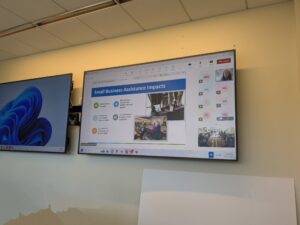
And so many folks might have surveyed businesses. We collected about 400-plus business surveys with a lot of the small business assistance efforts and programs that the cities participated in. Over 900 businesses were assisted. 600 of them were women and minority-owned businesses. That was also a new metric that we wanted to start collecting and understanding in terms of how many women and minority-owned businesses were impacted by these types of efforts.
Over $1 million of funding was secured for businesses in the forms of loans or grants, and 75 events were hosted. So all around, very interesting metrics came out of just this one category of small business assistance.
As per the buy local and placemaking impacts, you’ll see a couple fun photos we have. You might recognize Derek’s back from the city of Tukwila. That was an event that they hosted last year with the Somali Independent Business Alliance. Some of the cumulative impacts: over 27,000 attendees to events, 1,000 businesses participated. Truly impressive impacts and collective work from the cities across King County.
Some of the tourism impacts because our Economic Development City Partnership Grant also funds tourism marketing campaigns and efforts. You’ll see that in the bottom right corner, there’s some fun images from the city of Enumclaw and others across King County highlighting some of the events that generated over 200,000 attendees to events and 9 million marketing impressions, visitors from six countries and 36 states. Again, massive impacts from just this one year of funding.
I will caveat that given this as an annual grant cycle and in reality, a lot of the contracts were – there’s an application period and entering a contract takes time. So in reality, a lot of these impacts were actually collected within a six-month period, so I’m very pleased with what has been completed by end of last year.
So moving on to what’s to come for 2025 and 2026, we are moving actually back to a two-year funding cycle. Last year, we had a one-year funding cycle just to better align with the city’s biannual budgets, and this was actually some feedback we heard from our city partners, so closely working with them to see how we can constantly improve this program.
Largely, a lot of the things will remain the same. The grant award amount and required match, and then folks can use their application to apply for a two-year timeline in terms of the projects that they’d like to implement. The funding is for a two-year cycle, so they can apply for the amounts that we were giving annually, but times two, essentially, and they don’t have to spend all of the funding evenly throughout the years. If they want to front-load some of that funding or wait to spend it for 2026, we happily work with the cities to do that and have it written in the contracts.
So for the two-year grant cycle, some of the focus areas that we have in terms of – a lot of these project categories actually largely remain the same. I would say probably one of the newer ones we have added is an export trade and assistance promotion category where folks can work closely with their businesses to help promote – we try to design some of these categories around some of the other economic development efforts that we support and work with other partners like Greater Seattle Partners who has export accelerator programs. So finding ways that a lot of these investments and help support each other, there’s an ecosystem.
And again, largely a lot of the projects can help support things that align with the Port’s interests and using our infrastructure, such as Sea-Tac airport, terminals and the cargo terminals. We are also putting a stronger emphasis on aviation, maritime, and construction trades and green jobs and working very closely with cities to develop some of these ideas.
And A and I have in the first six months that A’s been here, we’ve been meeting individually with a lot of the city economic development folks to hear what they have in store for what they plan on applying for and just fine-tuning and being a thought partner through this process. So more to come on that.
And so for the next five or so slides, I’ll just briefly cover some of the past projects and what this Economic Development City Partnership Grant has funded in the past. You’ll see here Burien, actually most recently in the 2024 cycle, used some of the funding to support that hotel attraction marketing program to see if they can attract a hotel into the city. Also, one of my favorite projects that I was able to witness was a partnership with Urban League and pairing young adults with business owners and working on marketing plans. So there’s truly lots of value in terms of being able to work with different communities and upskilling the youth. So very creative ways to do that.
Des Moines also funded an economic development element most recently in 2024, and in the past, you may also be aware that it also – some of our grant funded the Marina Redevelopment plan. I think also, most interestingly enough, Des Moines had a food truck pilot program where they partnered with the Food Services Association and tried to activate part of the marina by encouraging more food trucks there. So lots of fun ideas!
Another detail is that we’ve started a resource library so given that there’s so many wonderful projects that cities come up with, we want to be able to share this across cities for others to replicate, and so just last year, we’ve started an external SharePoint where a lot of our city economic development folks can glean from past projects and be able to brainstorm around it, connect with each other, and implement it on their own space.
With Federal Way, they also funded some business outreach last year, and then also developed a huge photo library of assets, one-pagers trying to market the city of Federal Way as a great place to locate businesses and trying to attract national businesses to locate there. So lots of great things happening there as well.
And in Normandy Park, they worked with the Southside – that’s Southside Chamber – to host a number of different business mixers and worked with women and minority-owned businesses. Also developed some marketing videos and surveys. Great work there as well.
And in SeaTac, this is a photo of some farmers markets that were hosted in partnerships with Hmong Seattle. They also continued some small business surveys to understand the current conditions and what businesses are facing and to better serve them. Again, great work with our city partners in SeaTac.
And here is Tukwila. I’ve mentioned this is another photo from that Somali Independent Business Alliance. Other past projects that they’ve funded was a joint partnership, the Green River Valley Washington website to attract businesses into the valley area, and they also have done some tourism marketing campaigns for Experience Tukwila.
And so all in all, today, I’m just here to let you all know that our application window is currently open. It is open as of last month, and the deadline to apply is August 15th. We did host an application workshop last month when the grant application window opened as well as two weeks ago. We hosted an in-person meeting with our city partners, an opportunity for them to ask us questions and other city partners brainstorm collectively around different topic areas and get ideas from each other. So very excited for what’s to come in the next few years, and I will – I think that’s the last slide – answer any questions you all might have. Thank you for your time today!
Moderator: And just as a reminder, all the presentations from the Forum will be posted at the Port’s Highline Forum web page, usually within a couple days, but by early next week. Anyone have any questions?
Question: I was wondering if there was a prioritization of anything related to FIFA the World Cup coming in, or is that going to be separate kind of activity? Will the Port be providing some additional help for cities as they ramp up and prepare for that?
Annie Tran: That’s a great question. I should have also mentioned that with this Economic Development Partnership Grant, cities can apply portions of their funding to help support any World Cup efforts. And I know that there’s been a lot of interest from city partners. I know that some of the Eastside city partners have maybe even hired a World Cup planning manager, so hopefully we can all as a region learn from each other, see what each other is doing.
I have been asked by Alexander from SeaTac to convene some of our city partners who are interested in hearing about what other cities are doing, so I’m hoping within the next month you can just gather an informal group of interested economic development folks to see what their ideas might be, how they might maybe focus their funding for this funding opportunity towards those FIFA World Cup efforts and always we’re trying to encourage collaboration knowing that our dollars go further together, so hoping that some of these I consider maybe regional campaigns or something along those lines.
Moderator: Excellent. I know that the Highline, I think it’s called the Highline Partnership group or something like that. It’s based, like Nancy Saguenay McKay has been working on that through the Highline Heritage Museum, and there’s been meetings that she’s been convening as well. So you might want to get in touch with her about some of that because it’s centered around what activities individual cities will be doing. So that might be a good resource.
Annie Tran: Thank you so much for that tip! In addition, the Port had been sharing the connection to the local organizing committee purposes of the cities being able to tap into purposes of being able to get watch party playbooks and other materials and branding during the course of next year, and we’ll continue to share that out.
Moderator: Yeah, it’s kind of interesting because everyone’s still like exploring Seattle Southside and Chamber and Museum programs. And like, I think they’re still trying to wrangle everybody.
Armen Papyan: I have a more broad general question. Considering the impact at the federal level from tariffs, are there any concerns on how that will impact funding these really amazing grant opportunities available?
A Boungjaktha: That’s a fantastic question. As far as I know, this current Economic Development City Partnership program is funded by property tax levy dollars, I believe, so not affected. It’s a great question. I think that for this particular program, I don’t see it really being impacted. It’s really our local dollars, and thank you to you all as members and residents of King County for allowing us to have the ability with the communities to figure out innovative ways and wonderful ways to create those jobs and bring investments into the region.
But there definitely are cities that are concerned, and we’ve heard through our various conversations with them as I’ve been onboarding for the past few months that there are some serious concerns about what that means for some of our neighbors, right? So some of these cities do depend very much on federal funding and not so much tariffs, but they will see the impact if jobs are affected by it, companies, small businesses that really rely on import-exports.
We do a lot of both in our region, because our state is one of the most trade-dependent states in our country and the West Side, but also on the East Side. So I think that a lot of our communities will feel the impact of what the federal policies are, but fortunately, for this particular program, the cities have a really great opportunity. It’s not the biggest source of resources in terms of funding, but I believe that the cities really find it valuable because it is some funding and we become thought partners.
So even though some of the smaller cities, unlike yours, but some of your other colleagues and other smaller cities, really see this as a valuable asset for them as they try to figure out how to do the most with the smaller resources that we’ve got available, and we become a partner, an extension of their teams. So you’re looking at two of their extended partners who say Annie, myself, and other folks at the Port, too. We really enjoy that partnership, so that’s what I think I love about most about this program is the fact that we are really partnering on trying to develop how we do this work together as a region and county. I hope that answers your question.
Response: Oh, thank you for that in-depth answer. I know, as a council member, I appreciate it. We really appreciate this source of revenue and support, especially as our expenses are increasing. So something that’s really valuable to us, I know it’s a small part of our budget, but it’s very, very helpful.
Moderator: Anyone else have any other questions? No. Then thank you again, Annie and A. As I said, I know economic development staff and people appreciate the partnerships with the Port, and I’m sure other cities do as well. And with that, we’ll move forward to our round table updates.
Highline Forum City Updates
Moderator: At this time, we can go around the table, so each Highline Forum member may update the group on any emerging issues, opportunities, or other items. I’ll turn to Dave Kaplan to call on people by organization, beginning with educational institutions and cities.
Dave Kaplan: I saw Joe Vinson. Are you still with us, Joe? No, okay. From Highline College, Josh Gerstman noted that he had to go to Foster High School for the announcement of the Tukwila Promise, which will increase college-going rates of Tukwila graduates and wanted to share that they have that the college has its first Spanish language billboard now in Burien on First Avenue and 156th near the O’Reilly Auto Parts. So reach out to the Spanish-speaking community. That’s from Highline College.
Okay, from the Port of Seattle, Commissioner Cho.
Port of Seattle Commissioner Sam Cho: There’s so many people on the call here. I wasn’t sure when to while. I just don’t have major updates. I just want to thank the team for showing up and the presentations here. Thank you.
Claire Gallagher (Port of Seattle): Commissioner, this is Claire. If I could just add, just to highlight a couple things that you had at your commission meeting yesterday for the benefit of the group is presentation on our workforce development programs and minority contracting programs. Both of which are really robustly supported, and we’re seeing great growth year over year. Really important, obviously, the size of the work that we undertake to meet both of those targets.
The other thing is we, the commission voted to authorize money for design to renovate the South Concourse at SeaTac. Some of us used to call it the South Satellite, and that’s a project that we’ve been working our way towards for a number of years. The North one has been done. Now it’s the South one when they get to be about 50 years old. You kind of have to do something. So anyway, that’s those are the two major items from yesterday, and you heard the StART presentation which the commission also heard.
Dave Kaplan: Okay, city of Tukwila.
Aryen Papyen (Tukwila): So I was actually supposed to be at Foster High School at the Tukwila Promise event, but I chose to be here. I had to delegate this meeting. There’s an event going on at Foster High School. The Tukwila Promise is an amazing program that we recently passed as a council and partnered with the state to – all our graduating seniors from Foster High School that will guarantee them two years of free education at Highline College. So we’re looking forward to that and seeing students enroll at Highline and giving them that opportunity of attending higher education and getting a degree.
But we had a number of events coming up, and you’re all invited to join us from World Refugee Day at Foster High School, which will be on June 28th from 12 to 5 PM. We’ll have many non-profits being engaged, government agencies and organizations. And then a Juneteenth celebration, which is also on June 19th from 11 to 1 at Tukwila Community Center. Every year, this event has been growing. We hosted out of the city and it is really beautiful to see so many people coming together in one single space.
And then we have a Foster Golf Scramble on June 28th to the 29th. Then there’s the People’s Project. It’s part of the participatory budgeting community exercise that the community will go through and it’s open to community members, residents, to suggest a different project they want to work on our city that they want the city to work on, and there’s a budget of $50,000. And on May 31st, which is this Saturday coming up, there will be the groundbreaking event for HealthPoint clinic and many residents, not only at Tukwila, but around the region will be utilizing that clinic, so you’re looking to attend that groundbreaking event, which will be at 10 AM.
And then, last but not least, on June 6th, we had the Seattle Sounders match, which is their Pride match and is sponsored by the city of Tukwila. And that’s pretty cool right there.
Dave Kaplan: In the city of SeaTac, Council member Vincent.
Council member Joe Vinson (SeaTac): Hey there, everyone else. Yeah, I’m happy to take this off. I got a couple of updates for the Forum here. The city of SeaTac has presented the Port of Seattle with a formal offer to purchase Des Moines Creek Park and Tyee Ryan Field. This is going to be more than just a real estate transaction. It’s a long-term investment in kind of resilience, public health, and equitable access to green space.
Our offer is proposing to acquire 213 acres, and we’re committed to investing up to $20 million into the park over the next decade. So this offer is currently sitting at the Port of Seattle. I’m really excited about this. Our community is really excited about this. So we’re just waiting with bated breath to see if the Port of Seattle will accept that offer or counter or have a counter proposal, but I’m really excited about that.
The next item that I do have on my list here is that the city of SeaTac held its first ever State of the City event at our community center earlier this month, led by Mayor Mohammad Gaul and our – I still say new – city manager Jonathan Young. We had a great turnout. We received a ton of feedback. In short, the state of the city for the city of SeaTac is strong. We’re resilient.
Next update, and I’m surprised I didn’t hear much about this topic – Fourth of July. So the city of SeaTac, we made the tough decision to pause our Fourth of July celebrations at Angle Lake Park, decided by some concerns from our staff. Also, FIFA will be in town, so we just have to prioritize and recalibrate. This department intended for the next two years. So there’s that.
And last, but not least on my list here is SeaTac’s farmers market. We’ll begin next week. It will be weekly, every Wednesday at the Matt Griffin YMCA. This will prioritize BIPOC producers. It operates without vendor fees, making it an economic and equitable asset that the city of SeaTac is very proud to support. That’s all I have.
Dave Kaplan: Thank you for that, Council member Vincent, and just one very short addition. This Saturday, May 31st at 10 AM, the city of SeaTac and city of Des Moines will be co-hosting a groundbreaking on the SeaTac Des Moines Creek Trailhead as well as we had that construction getting underway and exciting progress being made off of 200th Street, just south of Sea-Tac International Airport.
City of Federal Way, Bill Vadino.
Bill Vadino (Federal Way): Well, greetings, everybody. You can see Federal Way there in the background now right there, but it’s just blown out by the sky and the sun, but very briefly. We just had a great thing happen three weeks ago and it’s basically the family that was doing the city of Federal Way farmers market for 21 years decided to retire, so the city transitioned it. The daughter is the manager. A friend of hers is the events manager, and so now, the 22nd year is occurring together, a collaboration with the family and the city, and the farmers market successfully opened.
Now, what’s interesting is, you think farmers market, but this, like your other city farmers markets, is a food oasis. And when someone with WIC or the other tools comes in, they get their money doubled. And then, of course, we have a hospital that also gets funds. And we are basically an oasis for people, and we’re going to be characterized as not a food desert, so that was a great event to keep that going. It’s also a community meeting place, very essential. And so we’ve got plans to really bolster that with everything we’ve got. We’ve been a supporter for years, but it’s nice to have it under the umbrella, but we couldn’t do it without all the volunteers who have done it over the last 21 years. They’ve continued to feel supported to be there.
We just had a very successful senior health fair, our Senior Commission, which I believe is like four years old, puts that on every year, and it had over 60 exhibitors, and that was at our Performing Arts Event Center.
A week from or next Monday, we have our Pride flag raising. That’s our fourth annual, 9 AM, it’s the city hall flag plaza. Then our Arts Commission, they’re going to have their Arts Explosion at our Performing Arts Event Center on May 30th through June 1st. That’s their second annual event.
And then, since 2020, we’ve been doing a Juneteenth flag raising, which was inspired by a Federal Way family. And so that’s gonna now that’s in its next iteration. What’s fun is the first time we couldn’t find a flag, so we had to paint one, and one side was very bright, and the other side was faded, and it was sort of like an echo of a scene from Invisible Man. Second year, we got a flag from the family that – the father went state to state to get Juneteenth become a holiday in all the states, and so the flag we fly here today or five with then it was from that family. That is now in our time capsule.
Our community walks the next day. And if you know the BPA trail that runs across Federal Way, basically, there are 40 historical events on the march. The Juneteenth recognizes and basically, residents walked that walk back and forth on the BPA trail and reiterate or learn their history, which the Port put some money into it as well as King County, city, and other people.
We will have the opening of the Hanawari Garden structure, which is from our city, our sister city in Japan, and that’s June 10th noon at Panther Lake Trailhead, which is next to the Weyerhaeuser Aquatic Center. It’s right there. Between there’s a little creek that runs between the Weyerhaeuser Aquatic Center, the King County Aquatic Center and this park, but it’s an incredible structure from Japan and Hanawari means friendship.
And then, of course, Pepe Kenworth is in the process of opening. We had an open house next week. Smith Brothers Daily Dairy is thriving as they’ve opened. And then Fourth of July, we will have our free festival. So come and join us. So anyway, we’ll have more events at our next quarterly meeting. If I don’t get this in here, yeah, we will be meeting before Lance always showed up for the great farmers market cherry – nine charities, nine restaurants, and you get nine samples for lunch and everything. So we’re gonna have to get some designated person from each of the cities to attend, so we’ll make sure we make that happen. And it helps nine different non-profits and restaurants. So thanks for being here today.
Dave Kaplan: City of Des Moines, Council member Mahoney.
Councilmember Matt Mahoney (Des Moines): Thank you, Dave. We continue to move forward on our capital projects since the last time we talked. We opened our restroom down at Redondo, has a shower for divers because it’s a popular diving site, and there’s a coffee shop going in retail to get down there. Check it out.
Also, the fishing pier should be going up to bid the first week of June. Steps are shortly thereafter coming in around the July-August window. So we get some stuff done that former Mayor Kaplan started, so the speed of government is amazing!
Just did our ribbon cutting for our Veterans Memorial. It’s a triangle on the beginning of the south end of the Des Moines Memorial Drive. The lighting goal and everything was broken. And wire didn’t work, so we didn’t have power and lighting sometimes to change the flags. It was manual to half-staff. We had ribbon cutting was tremendously successful, and it’s great. So our north entrance of town is what I’ll call respectable, not only to come into, but also in honor of, especially of those veterans that gave up.
Begin Saturday, June 7th. Those of you in SeaTac, send them our way. There’s still Federal Way and every other city where you plan on doing our annual drone show again this year. The Fourth of July, and of course, before we meet, we’ll have our annual Waterland parade on July 19, Saturday at 6 PM. Thanks, Dave. That’s what I got.
Dave Kaplan: Thank you. And that concludes our round table updates and our meeting for today. Thank you all for participating. Our next meeting is July 23rd, 2025. Thank you all.
Is there a way to see where on a map will the proposing to acquire 213 acres is located today. I also have a concern that the SeaTac farmer market is going to have a priority for BIPOC folks. I’ve yet to see any of our Farmers Markets not have a variety of folks participating from various parts of the world. Are the other vendors that are not BIPOC also being included? We don’t want to promote separation. I look forward to your respond at your earliest convenience.