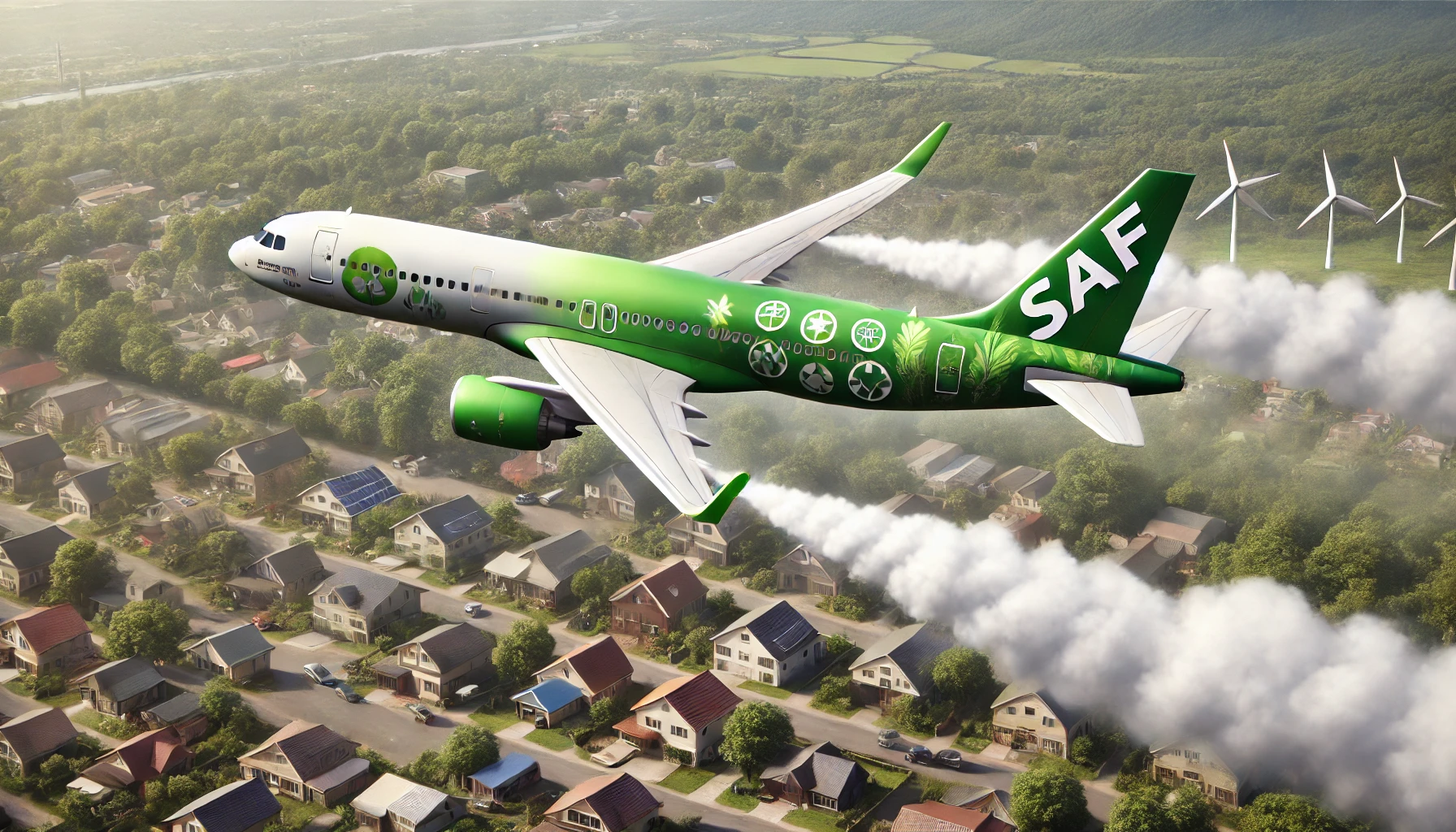
A Dangerous illusion masquerading as a climate solution
Sustainable Aviation Fuel (SAF) is being promoted as a climate-friendly alternative to traditional jet fuel. The term itself sounds promising—who wouldn’t support making aviation more “sustainable”? But beneath the marketing gloss lies a troubling truth: SAF is, at best, a distraction, and at worst, a calculated maneuver by the aviation industry to delay real climate action.
At Sea-Tac Airport and across Washington State, SAF is being championed by the Port of Seattle, state lawmakers, the FAA, major airlines, and even Big Agriculture. They are working together to build a supply chain to support widespread use of SAF—from new processing plants to on-site fuel storage to state-sponsored farming initiatives.
We view this as the aviation industry’s version of “recycling”—not the act of reusing materials, but the public relations campaign promoted by the plastics industry in the 1970s to deflect regulatory threats. Just as “recycling” gave cover to continued plastic production and pollution, SAF is being used to give the appearance of environmental progress while allowing air travel to keep expanding—along with its emissions, noise, and health impacts.
Watch this: PBS Frontline documentary on history of plastics recycling
What Is SAF, Really?
SAF refers to alternative fuels that can be used in aircraft instead of fossil-based kerosene jet fuel.
Ideally, these are drop-in replacements, meaning that they can be used with no, or minimal updates to aircraft engines. That detail is significant. Those old enough to have driven automobiles from the 1970’s know that manufacturers had to make several changes to engines over time in order to accommodate less polluting fuels.
These new fuels are often referred to as biofuels because they are made from a range of organic feedstocks:
- Used cooking oil and animal fats
- Municipal solid waste
- Forestry and agricultural residues
- Specialized crops like camelina
This feature alone, being sourced from ‘plants’, gives biofuels a certain ‘green’ cachet. However, SAF is almost always blended with fossil fuel (usually up to 50%).
Learn more:
- International Civil Aviation Organization (ICAO) SAF definition and standards
- U.S. Department of Energy: SAF feedstock analysis
Carbon neutral, not carbon zero
SAF creates green house gases exactly like fossil-based fuels. After all, it runs in the same engine, that is one of its greatest appeals. It is not carbon-zero, like an electric or hydrogen powered engine. So, why all the fuss?Two possible environmental benefits, one we agree with, one we find ridiculous. You decide.
SAF definitely reduces pollutants besides C02. It has far fewer impurities than fossil-based jet fuel. And those impurities contain many of the particles (including ultrafine particles) that rain down on us. Removing those is good. However, there is nothing preventing current refiners from creating fuels that are just as pure. They don’t because it adds to the cost, not because it is technologically challenging.
The main argument for SAF has to do with lifecycle carbon neutrality. This is so wonky it took us a while to understand. The argument goes like this:
- When you take fossil fuel out of the ground, you aren’t just burning it, you are adding to the total C02 load of the planet. It gets into the atmosphere. And then has to be somehow captured (perhaps by trees or some future machine) in order to remove.
- When you burn biofuels like SAF, you aren’t adding anything new. The C02 was already there in the cooking oil or sticks or whatever you’re using for feedstock.
But frankly, the reason the industry likes it is because it is, drop-in. Manufacturers say they have no better options and will not have for several decades.
The carbon neutrality myth
In theory, SAF can reduce lifecycle greenhouse gas emissions by up to 80%. But that reduction is highly dependent on feedstock, processing method, and assumptions. In practice, these assumptions often fall apart under scrutiny.
To be truly “carbon neutral,” SAF would have to:
- Use genuinely waste-derived feedstocks (not crops grown on arable land).
- Be processed using clean, renewable energy.
- Avoid emissions from transportation, refining, and land use changes.
- Be blended at high concentrations, which isn’t currently permitted beyond 50%.
Even under ideal conditions, SAF does not eliminate emissions—it only shifts them across the lifecycle. And in many cases, the benefits are overstated or based on questionable accounting.
A major study published in Nature (2022) found that biofuels from crops like corn and soy may have greater emissions than fossil fuels, once land use changes are considered.
Study: “Environmental outcomes of biofuel policies”
The Airlines’ SAF Fantasy
Airlines around the world are betting their net-zero climate pledges on SAF. They claim that by switching fuels, they can avoid meaningful cuts to air travel or emissions.
Here are examples from three major airlines flying out of Sea-Tac:
- Alaska Airlines: Path to Net Zero by 2040
- Relies heavily on SAF development and partnerships.
- Delta Air Lines: Net Zero by 2050
- Projects SAF as the most important piece of its strategy.
- United Airlines: 100% Green by 2050
- Boasts SAF investments and pledges despite minimal actual usage.
The Problem:
Current global SAF production is less than 0.2% of total aviation fuel demand, according to the International Air Transport Association (IATA).
IATA 2023 SAF Market Overview
Despite this, the industry expects SAF to account for 65% of their emissions reductions by 2050. That’s a bet on nonexistent fuel from nonexistent plants, backed by nonexistent supply chains.
How the Port, State, and FAA are pushing SAF
Washington State is emerging as a national hub for SAF—not because it’s working, but because powerful institutions are aligned behind it:
Port of Seattle
- Promotes SAF as a core strategy in its Century Agenda and climate planning.
- Partnered with Alaska and Delta on the “Sustainable Sky” initiative.
- Commissioned a 2021 SAF infrastructure study, which recommended building dedicated SAF blending and storage systems at Sea-Tac.
- SAF storage and distribution facilities are now explicitly included in the Sea-Tac Airport Master Plan (SAMP).
Port of Seattle SAF Infrastructure Study (PDF)
Sea-Tac SAMP Near-Term Projects – See Section on Fuel System Upgrades
Quote from SAMP: “Develop infrastructure upgrades to accommodate alternative fuels (including SAF), as part of fuel system modernization.”
Washington State Legislature & Agencies
- Passed the Clean Fuel Standard RCW (HB1091-2021), which rewards low-carbon fuels like SAF.
- Funded SAF research through the WSU Center of Excellence for Alternative Jet Fuels and Environment.
- Promotes camelina and other oilseeds through the Dept. of Agriculture, raising concerns about land use and industrial farming expansion.
WA Dept. of Ecology: Clean Fuel Standard
WSU SAF Research
Federal Aviation Administration (FAA)
- Actively funds SAF research, infrastructure, and policy development.
- Supports programs like the Aviation Climate Action Plan and the Cleen Program, both of which center SAF as a climate solution.
- Offers competitive grants for airports to install SAF infrastructure.
FAA Aviation Climate Action Plan
FAA CLEEN Program Overview
SAF doesn’t address what really matters
Here’s the truth: even if SAF were widely available tomorrow, it would not solve the real issues facing communities near airports like Sea-Tac.
SAF does not:
- Make planes quieter.
- Reduce ultrafine particle pollution (UFPs).
- Alleviate the sleep disturbance, school disruption, or health risks faced by overflown communities.
- Encourage people to fly less or the industry to shrink its footprint.
Instead, it gives the illusion of progress—a way for airlines and airport operators to claim climate leadership while continuing to expand.
Our Position: Reject the SAF illusion
STNI opposes the SAF narrative. Not because we don’t want to reduce aviation’s impact, but because we do—and SAF is a roadblock, not a roadmap.

It is the new “recycling”—a slick, feel-good illusion, designed by industry to prevent regulation, and encourage consumers create more pollution, guilt-free. SAF lets airlines sell “green” tickets. SAF does not even have to exist. So long as technologies like 1SAF are being worked on, they don’t have to. Whether these technologies exist or not, spending money on research allows the Port of Seattle brag about sustainability while adding gates and increasing flights using conventional fuels. SAF lets politicians take credit for climate action while avoiding hard choices.
What We Need Instead:
- Limits on airport expansion and air traffic growth
- Investment in rail and clean ground transit
- Noise reduction policies and health protections
- Transparent community engagement and environmental justice
SAF will not bring these changes. Only community pressure, regulatory reform, and demand reduction will.
1And other technologies decades in the future such as electric and hydrogen powered aircraft.