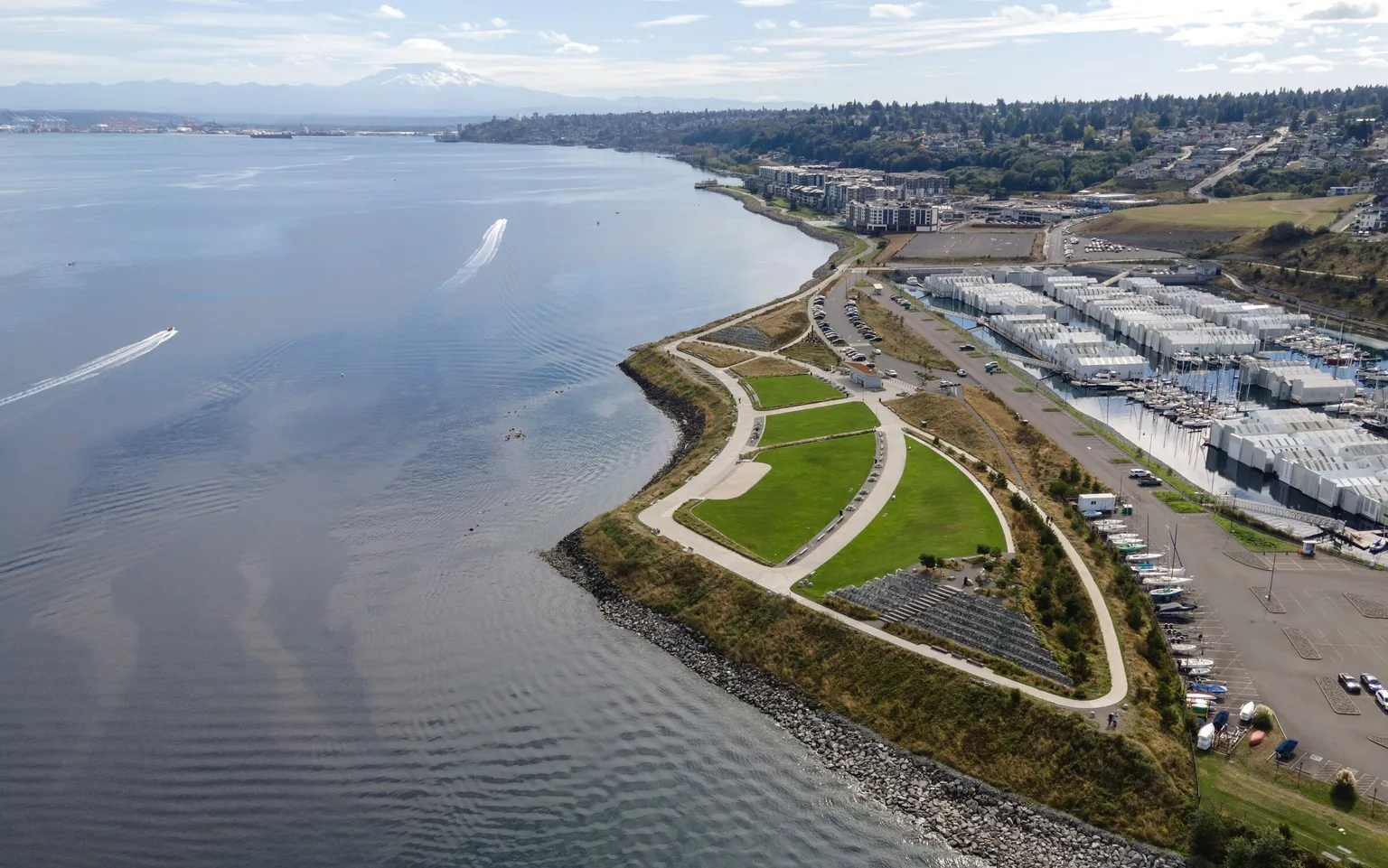
IF FUTURE ARCHAEOLOGISTS (whether aliens or, should we persist as a species, our own descendants) were to explore the city that might or might not still be known as Tacoma, they surely would visit its eerily beautiful Dune Peninsula at Point Defiance Park.
Wide-eyed, they would marvel at the surreal wonderland of narrow, lonely walking paths cut through swaths of open prairie coated in long, dryish grass wafting softly in the wind, like an abandoned landscape almost devoid of trees, giving the impression of vast, enigmatic wildness. The site is dominated by several minimalist, ziggurat-like stone mounds that whisper silently of ancient gods and lost rituals, mounds that can be scaled via those gently sloping paths or, more dramatically, via minimalist concrete stairs that are slightly too big for regular humans to climb without effort, forcing most of us to hoist ourselves up step by step, as if trespassing onto the temples of long-forgotten giants.
But if those future archaeologists (alien or otherwise) were to dig beneath the soil of these uncanny monuments, they would find no artifacts or mummies or hidden spaceships. Instead, they first would hit layers of vegetation and clean dirt, and then, perhaps even to their peril, a massive mound of contaminated slag and soil beneath.
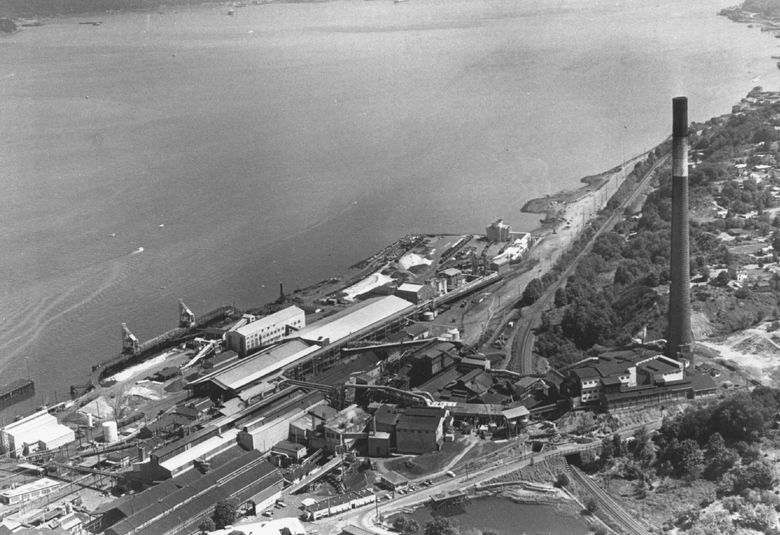
Dune Peninsula is located at 5361 Yacht Club Road on a triangle of land jutting into Commencement Bay that was, until recently, an EPA Superfund site where American Smelting and Refining Company (ASARCO) ran a 500-plus-foot smokestack for its industrial smelter, filling the area’s air, soil and humans with toxic heavy metals. This engineering marvel/environmental cancer is reportedly one of the primary inspirations for the ecological themes in the eponymous novel “Dune,” as its author, Frank Herbert, was a Tacoma local and grew up in its dark shadow.
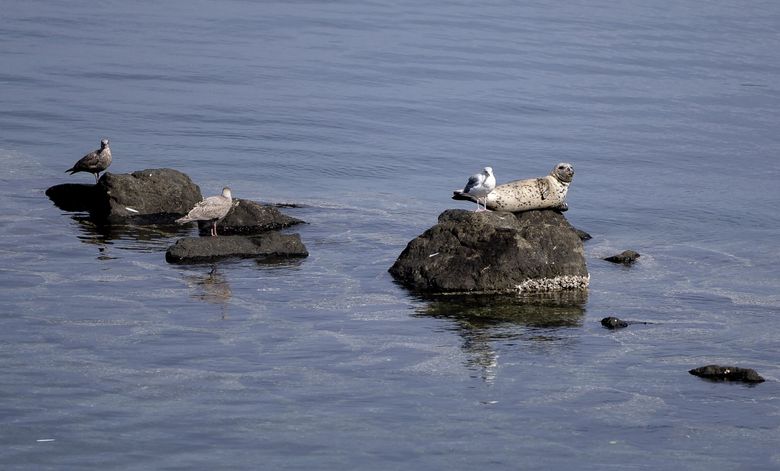
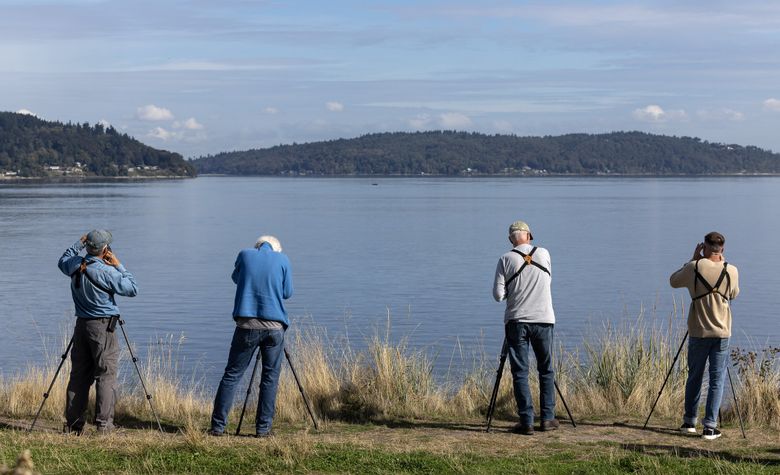
Herbert died in 1986 and never lived to see the smokestack demolished in 1993, but echoing the themes and events of “Dune,” the land subsequently was reclaimed and terraformed, and robust environmental remediation measures now protect the water from the soil, including the fat little seals sunning themselves on the nearby rocks, happily slapping their tails at park visitors watching from the path above.
Public artworks add to the gorgeous site’s aura of strangeness, like the arrangement of rusted metal cylinders — a piece by Oregon-based artist Adam Kuby called “Alluvion” — evokes the former smokestack, as if it simply had toppled one lonely day and been left to crumble on the site of its former dominion.
Turquoise tubes mounted on poles guide one’s eyes directly to mountains of interest such as Mount Rainier and Glacier Peak, and those who climb the ziggurats (for more views, perhaps) are treated to more artistic surprises, including a direct “Dune” reference in the form of giant bronze curves of overlapping armor like the fossils of massive pill bugs or armadillos, frozen critters meant to represent one of the life stages of the fictional sandworms that, in the novel, are the architects of the planet Arrakis’ deadly aridity.
From those heights, one can turn to see rows of uniform little white boathouses that comprise the adjacent Tacoma Yacht Club, an equally surreal little neighborhood-in-miniature with alleys and lanes of water like a flooded small town whose inhabitants must move between their homes on boats, another hint at a possible vision of a future far more wet but no less picturesquely ominous than the one offered in the pages of Herbert’s novels.