Notes
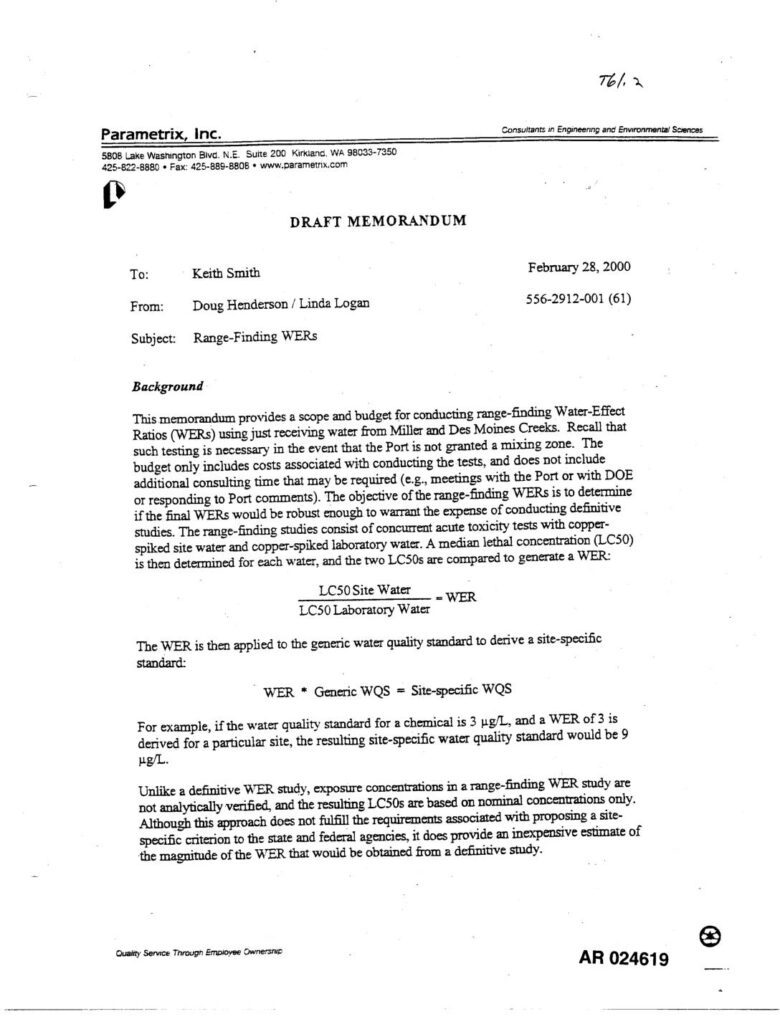
Draft memorandum (AR024619–AR024621) from Doug Henderson and Linda Logan of Parametrix, Inc. to Keith Smith, dated February 28, 2000, providing scope and budget for range-finding Water-Effect Ratios (WERs) using receiving water from Miller Creek and Des Moines Creek. Study necessitated in the event Port Of Seattle is not granted a mixing zone. Describes WER methodology using concurrent acute toxicity tests with copper-spiked site water and copper-spiked laboratory water, median lethal concentration (LC50) calculations, and application of WER to generic water quality standards (WQS) to derive site-specific standards. References February 23, 1999 range-finding results showing copper WERs of approximately 16, 7, and 15 for Miller, Walker, and Des Moines Creeks respectively under SDS3 stormwater mixing zone assumptions. Recommends definitive acute Ceriodaphnia dubia tests; cost table estimates $1,570 per test set, $2,110 for one site, $2,650 for two sites. Discusses dissolved oxygen monitoring equipment constraints for Walker Creek sampling. Project number 556-2912-001.