Notes
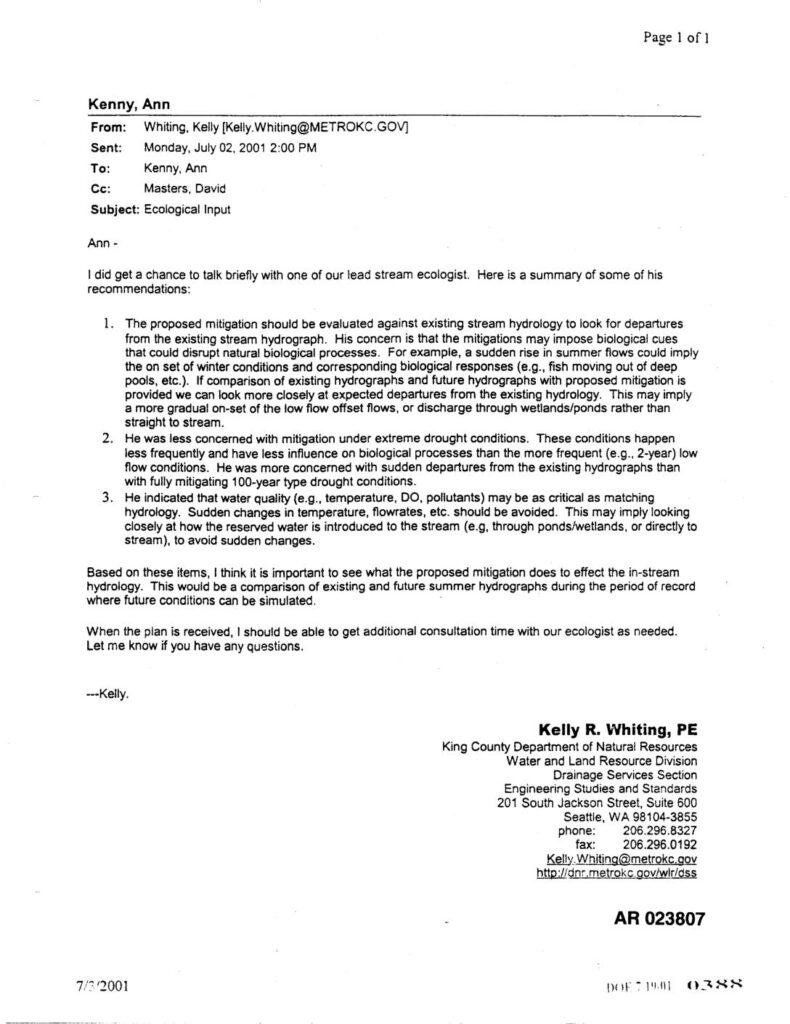
Email dated July 2, 2001 from Kelly R. Whiting (King County Department of Natural Resources, Water and Land Resource Division, Drainage Services Section) to Ann Kenny, cc David Masters, summarizing ecological recommendations from a lead stream ecologist regarding proposed mitigation impacts on stream hydrology. Three key recommendations address: (1) evaluating proposed mitigation against existing stream hydrograph to detect departures that could impose disruptive biological cues (e.g., fish movement, summer flow rises mimicking winter onset), with suggestions for gradual low-flow offset or discharge through wetlands/ponds; (2) lesser concern with extreme drought/100-year conditions versus more frequent 2-year low-flow conditions and sudden hydrograph departures; (3) water quality factors including temperature, dissolved oxygen (DO), and pollutants as critical as hydrology matching, recommending introduction of reserved water through ponds/wetlands rather than directly to stream. Document is part of Third Runway EIS administrative record (AR 023807) filed with the Pollution Control Hearings Board (PCHB), State of Washington.